
The PT:DD ratio could be the hidden reason you keep failing evaluations. It’s one of the most important yet overlooked metrics in prop firm trading, which might be working against you.
It compares how many percent you need to make in order to pass your challenge vs. how many percent you’re allowed to go into drawdown before you lose the account.
In this article, we break down how it works, what an ideal ratio looks like, and why understanding it can help you get an advantage when picking which prop firm to trade with.
Key Takeaways
- The profit-to-drawdown (PT:DD) helps you measure the difficulty of a prop firm’s challenge.
- Most prop firms require an 8%-10% profit target with a 10% drawdown.
- The ideal PT:DD ratio is 1, allowing for more room to create trading strategies and the potential to gain as much as you can risk.
What is a Profit-to-Drawdown (PT:DD) Ratio?
In prop firm trading, the PT:DD ratio (Profit-to-Drawdown) is a risk metric used to assess the difficulty of a prop firm challenge. Let’s quickly break down what this ratio is comprised of.
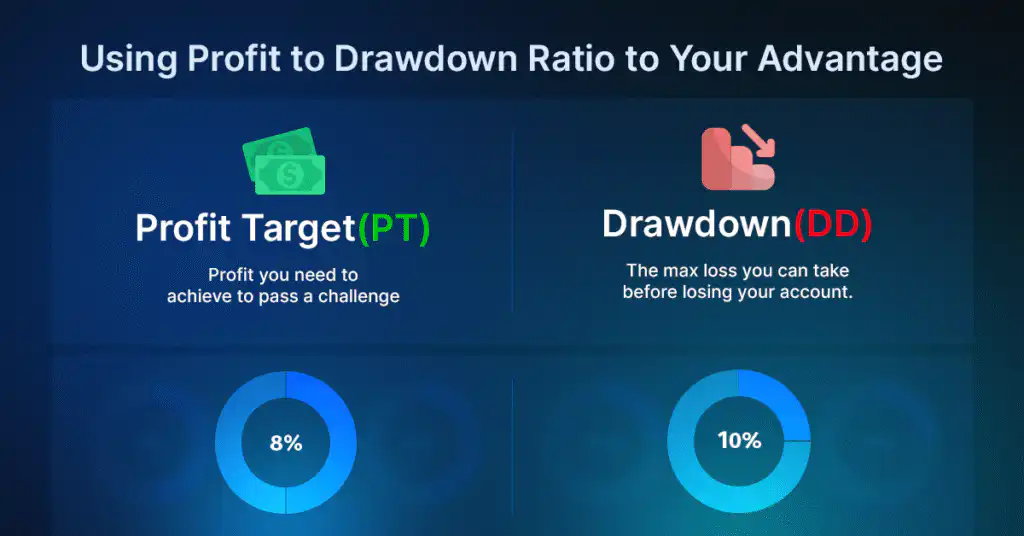
Profit Target
A Profit Target is the percentage of profits a trader must achieve in order to pass his prop firm challenge or proceed to the next phase of the evaluation.
Many prop firms now offer Instant Funding (no challenge phases) or one-step evaluation accounts, but the standard model for Forex prop firms is 2 phases:
- Phase 1 with an 8% Profit Target
- Phase 2 with a 5% Profit Target
Futures prop firms work with only 1 phase, often with a Profit Target of 6%.
Drawdown
Maximum Drawdown refers to the percentage of the account balance that a trader is allowed to lose before losing the account itself, regardless if it’s an evaluation or a funded account.
There are a few different types of drawdown, which we’ll break down in our separate guide here. For the purpose of PT:DD Ratio, we always use the Maximum Drawdown.
Forex prop firms work with a Maximum Drawdown of 10% in most cases, while Futures prop firms often use 3%.
PT:DD Ratio
The PT:DD Ratio compares the Profit Target to Maximum Drawdown. It’s how many percent you need to make in order to pass your challenge vs. how many percent you’re allowed to go into drawdown before you lose the account.
PT:DD Ratio = Maximum Drawdown / Profit Target
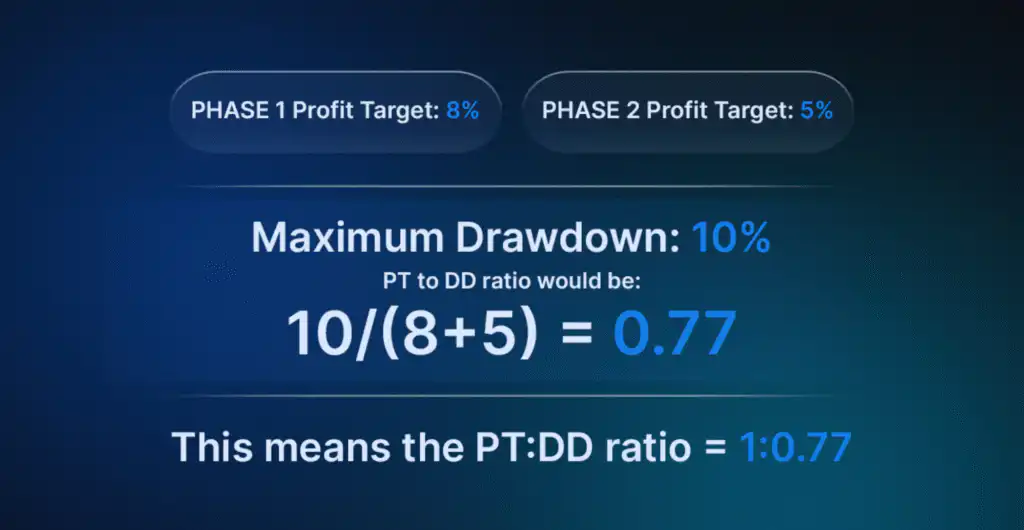
A standard Forex prop firm with a 2-phase challenge has a Profit Target of 8% in phase 1 and 5% in phase 2, making a total Profit Target of 13%.
If the Maximum Drawdown is 10%, the PT:DD ratio is calculated as 10%/13% = 0.77
Most Futures prop firms have a Profit Target of 6% and Maximum Drawdown of 3% for their evaluation. This means traders have to work with a lower PT:DD Ratio of 0.5 (3%/6%), making it harder to pass the evaluation.
Understanding The PT:DD Ratio To Your Advantage
A higher PT:DD Ratio means that the challenge is easier to pass since it gives traders more room before reaching the Maximum Drawdown, relative to reaching the Profit Target.
Conversely, a lower PT:DD Ratio means it’s more difficult to pass the challenge. The Maximum Drawdown is a lot smaller compared to the Profit Target traders need to reach, making it easier to lose the account. Forex and Futures prop firms have their differences in terms of PT:DD Ratio.
The Ideal PT:DD Ratio for the Right Price
Generally, the closer to 1 the PT:DD Ratio is, the easier the evaluation is. Traders have a lot more Maximum Drawdown to work with, relative to the Profit Target they need to achieve.
A high PT:DD ratio looks ideal for new traders, but it may not be a realistic target where you are expected to gain twice as much as the risk you take. A low PT:DD ratio is offered by prop firms with expectations of traders taking a cautious approach to earning profits. These reasons are why a PT:DD 1 ratio is ideal for its realistic goals and risks.
PipBack urges traders to keep the following details in mind:
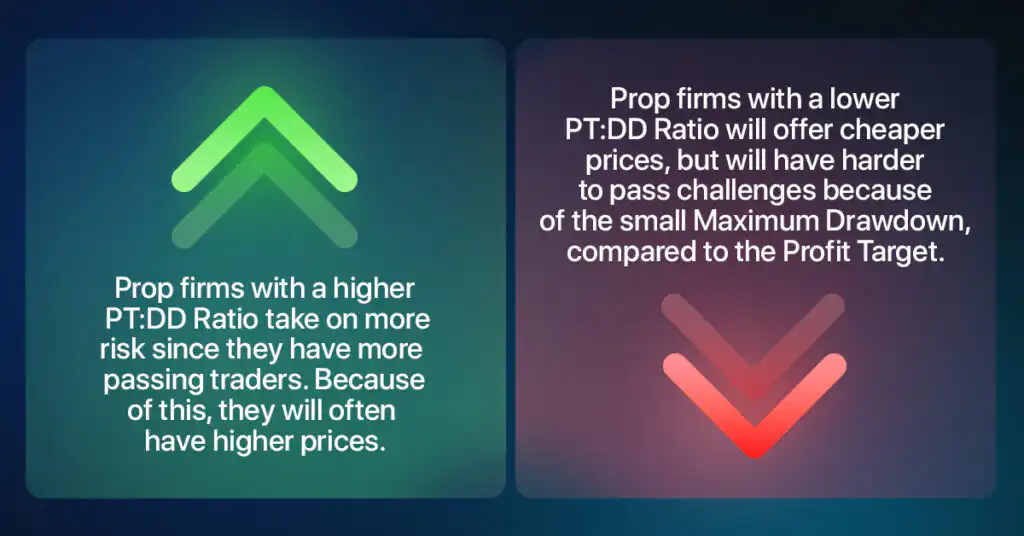
A better PT:DD Ratio doesn’t always have to mean a more expensive challenge.

FAQs
- What is a Profit-to-Drawdown Ratio?
A PT:DD Ratio compares the Profit Target to Maximum Drawdown of your prop firm challenge.
It’s how many percent you need to make in order to pass your challenge vs. how many percent you’re allowed to go into drawdown before you lose the account.
- What’s the best PT:DD Ratio?
While there’s no best PT:DD Ratio for all traders, the closer to 1 the ratio gets, the better.
Having more Maximum Drawdown to work with relative to the Profit Target makes the challenge easier to pass.
- Are Futures or Forex prop firms easier to pass?
Forex prop firms tend to have a higher PT:DD Ratio. There is more room for error relative to the Profit Target you need to reach, compared to Futures prop firms.
However, Futures prop firms have a lower Profit Target and only 1 evaluation phase, as opposed to 2 evaluation phases and a higher Profit Target in Forex prop firms.
- What is a trailing drawdown?A trailing drawdown is a dynamic limit to the amount you can lose, which moves up as you build up your account’s capital grows. This requirement is usually given to instant funding traders, who follow a strict requirement on their loss limits.
- What does the PT:DD not account for?The ratio does not consider the probability or chances of you reaching the profit target or breaching the drawdown limit. It can only tell you the relationship between the two metrics of a prop firm’s challenges. It also does not consider the market conditions such as Forex or commodities.