
Forex and Futures prop firms have come a long way in the last few years. It’s no longer just one evaluation type that can get you funded, traders have multiple options to choose from.
Let’s go over the evaluation types prop firms have to offer, and their pros and cons.
Key Takeaways
- Before you can start trading with a large capital, you need to pass a prop firm evaluation.
- There are two to three challenge tiers with the cheapest ones having stricter rules and profitability requirements.
- Instant funding is available for those who wants to skip the evaluations. However, those who choose this option must follow strict trading rules.
What Exactly is a Prop Firm Evaluation?
A prop firm evaluation is a challenge account traders can purchase for a certain amount of money, which in turn gives them capital to trade with, if they successfully pass their evaluation phase.
Instead of depositing funds into a brokerage account, prop firms let you undertake and pass a challenge, allowing you to trade anywhere from 4 to 6 figures in funded capital.
Types of Evaluations
Prop firms used to have only one type of evaluation back in the day. But as the prop firm industry developed, more options were introduced, and traders can now choose from multiple evaluation types, according to their preferences.
N.B. We will be using “Step” and “Phase”, as well as “Evaluation” and “Challenge” interchangeably throughout this article.
1-Step Evaluation
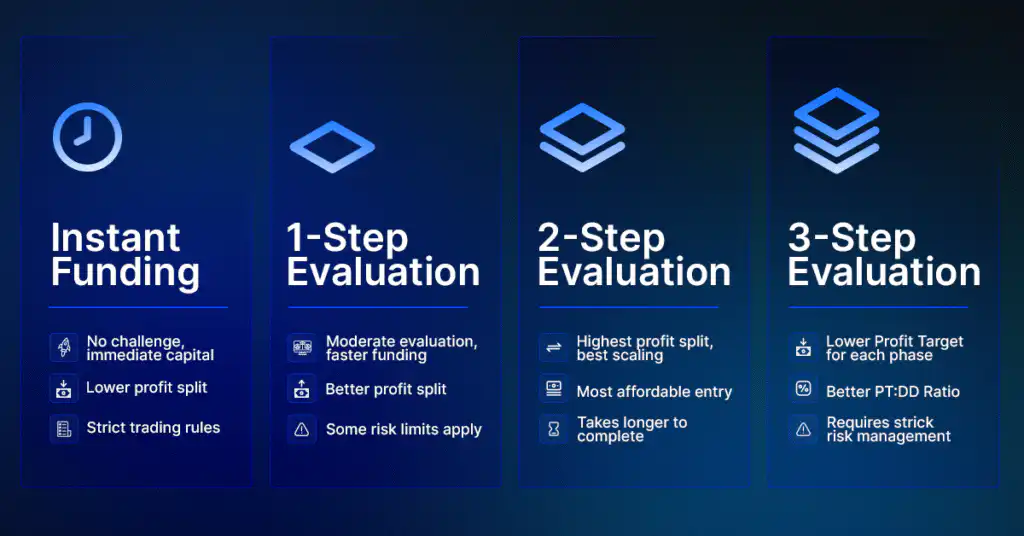
1-Step Evaluations are marketed as easier to pass because of it does not have a 2nd evaluation phase. But this is often not the case, since traders have less Maximum and Daily Drawdown to work with, to compensate for the lower Profit Target.
For example, a 1-Step Evaluation with a 10% Profit Target will have a 6% Maximum and a 3% Daily Drawdown, compared to 10% and 5% in a 2-Step Evaluation.
This is a 1:0.6 Profit-to-Drawdown Ratio, meaning traders have very little Daily and Max. Drawdown to work with, essentially limiting the amount of losses they can take to just a few.
For comparison, the PT:DD Ratio of a 2-Step Evaluation is 1:0.77, making it more favorable as traders have more drawdown to work with.
2-Step Evaluation
This is the original prop firm evaluation model. It was first introduced by FTMO back in 2015, and required traders to pass an evaluation with 2 phases.
Phase 1 usually has an 8% Profit Target, while Phase 2 has a 5% Profit Target. This means that the trader must make a total of 13% profit across both phases, while maintaining the 10% Maximum Drawdown (and 5% Daily Drawdown), in order to pass the evaluation and reach the Funded Phase.
This is also the most widely used and preferred evaluation in all prop firms. In terms of a Profit-to-Drawdown Ratio (PT:DD Ratio), it’s the most favorable since traders have a lot of drawdown to work with for the Profit Target they need to reach.
PipBack recommends going for a 2-Step Evaluation whenever you’re considering a prop firm evaluation. It’s the perfect middle ground and the most trader-friendly challenge.
3-Step Evaluation
Some prop firms have started offering 3-Step Evaluations, which market lower Profit Targets for the sake of an extra evaluation phase.
Traders are set to make 3-5% profit in each of the three phases in order to pass the evaluation.
For example, a prop firm with a 5% Profit Target will also offer 5% Maximum and Daily Drawdown. While technically, this is a 1:1 PT:DD Ratio, traders often overlook that this is a combined 15% Profit Target before they get to the Funded Phase.
Prop firms that have a 3% Profit Target per phase will have 3% Maximum Drawdown, severely limiting the number of losses a trader can take.
This means that with very strict Risk Management, a trader is still set to make 9% total profit before getting funded.
PipBack recommends considering a 2-Step or even 1-Step Evaluation instead of a 3-Step one, whenever possible.
Instant Funding (Straight to Funded)
The newest addition to prop firm evaluations isn’t really an evaluation; it’s getting instantly funded.
Prop firms now sell Instant Funding, which means that you can just purchase funded capital for a higher price and immediately start trading it.
The Maximum and Daily Drawdowns are still stricter and lower in these accounts, for example, 5% and 3%. Traders also have Consistency Rules to work with, since they are directly exposed to getting potential payouts, and prop firms must limit their risk.
We recommend purchasing these accounts only when you have proven to be consistently profitable and you can maintain an account for a long period of time.
Blowing Instant Funding accounts will cost you a lot since they are the most expensive prop firm accounts right now. Prove yourself as a trader first, and opt for the cheaper evaluation accounts.
Evaluation Addons
Some prop firms offer add-ons that you can purchase for your evaluation account. There are a few types of addons, mainly:
- Swap-free: This addon removes swap fees from holding your trades overnight, making the account suitable for swing traders.
- Shorter payout cycle: This addon allows you to shorten your payout cycle and request more frequent payouts from the prop firm. It usually shortens it from 14 to 7 days.
- Daily Drawdown: Some prop firms offer add-ons that increase the trader’s Daily Drawdown.
- Fee Refund: Most prop firms no longer refund your evaluation fee once you pass. Instead, this is now available as an add-on.
Trailing vs Static Drawdown Across Evaluation Types
There are two types of drawdowns when it comes to those taking the challenges and traders opting for the instant funding. Below is a detailed discussion of both:
- Static Drawdown: These is the drawdown rules given for the challenges where your loss limit is fixed or static. If you have a drawdown of $9,000 and a starting capital of $100,000, your static drawdown is set to $91,000. Even if your account reach $110,000 of capital, your drawdown stays at $91,000.
- Trailing Drawdown: This is why instant funding is stricter. Using the same example of your drawdown of $9,000 and a starting capital of $100,000. Even if your capital grows to $120,000, your losses should not make your account go down beyond $111,000.
Reaching the Funded Stage
Passing a prop firm evaluation means you get a funded account where you trade virtual capital provided by the company.
You can then get a profit split (usually 80:20) from any profits that you make, and withdraw them.
Prop firms will still monitor your funded account to make sure you are not gambling or over-risking. If you get to a payout, most companies offer biweekly, monthly, or even weekly payouts.
Best Deals and Evaluations
The 2-Step Evaluation remains the most straightforward prop firm challenge for traders. While there are some favorable 1-Step Evaluations for traders with very strict risk management and a high win rate, PipBack recommends going for the standard funding model, especially in the beginning.
When you’re experienced enough and have proven to be able to trade consistently, Instant Funding becomes a lot more lucrative, despite the high costs.
We have partnered with prop firms that offer all kinds of evaluations: 1-Step, 2-Step, 3-Step, and Instant Funding.
You can get the highest discounts in the industry for whatever type of evaluation you end up choosing.
FAQs
- What is a prop firm evaluation?
A prop firm evaluation is a challenge traders need to pass, by reaching a certain Profit Target, in order to receive funded capital to trade with.
- How many prop firm evaluations are there?
Currently, prop firms offer 1-Step, 2-Step, 3-Step, and Instant Funding accounts.
- What’s the easiest prop firm challenge?
Every prop firm challenge has its pros and cons. The 2-Step Evaluation remains the most straightforward and easy-to-understand prop firm challenge to date.
- How does the consistency rule affect traders?With a limit on a single-day profit, the ones likely affected are news traders and trend followers. Their trading strategy involves entering the market during significant events, such as annual financial reports or product launches. Those strategies can result in profits that exceed the consistency rule limit.
- Which traders are least affected by the consistency rule?Day traders and scalpers are less likely to breach the consistency rule. The profit target for both trading strategies tends to be much lower than for other strategies.
- What is the best way to select a prop firm challenge?Use your personal win rate on previously made trades as your basis. If you made a profit out of 60 trades out of 120 for example, your win rate is 50%, which is suitable for phase 2 challenges. You try a demo account on various exchanges that lets you trade with virtual money. These accounts let you grasp on your realistic win rate.