
Most traders fail prop firm challenges not because of strategy, but because of poor risk management. Prop firms come with the opportunity of trading large capital, but often with strict risk management rules.
Understanding and following these rules is essential to becoming a profitable trader.
In this article, we’ll cover:
- What risk management is
- Why risk management is important
- How to have proper risk management trading prop firms
What is Risk Management?
Most traders think Risk Management means just how many percent of your account you’ll risk per trade. But in truth, Risk Management includes a ton of other factors, all crucial to one’s trading career.
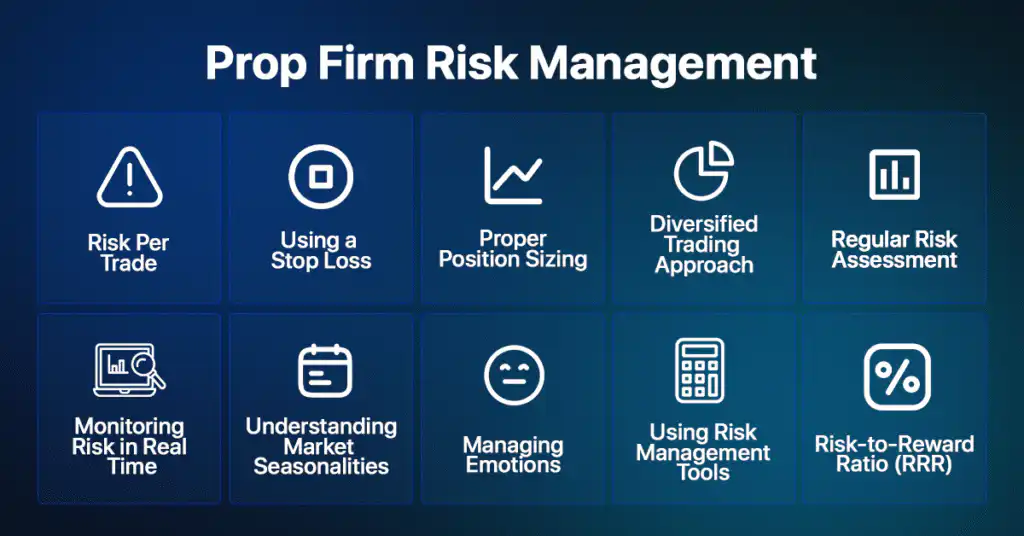
Risk Management includes all of these things:
1. Risk Per Trade
Defining your risk per trade beforehand is crucial and is the foundation of Risk Management.
Risk too much and you carry the risk of going into a big drawdown or even blowing your account.
Risk too little and you’re better off investing in the S&P500 for better returns.
It’s an industry standard to risk anywhere from 0.5% to 1% per trade. This means that if you’re trading a $100,000 prop firm account, you’ll be risking $500 or $1,000 per trade.
2. Using a Stop Loss
Needless to say, not using a Stop Loss is detrimental to one’s trading since it’s supposed to limit how much you end up losing per trade and goes hand in hand with your Risk Per Trade.
Imagine risking $1,000 in a trade as in the example above. The Stop Loss ensures your loss is capped at $1,000, and you don’t end up losing more or your entire trading account if the trade goes against you.
3. Proper Position Sizing
Knowing the correct position size you’re supposed to execute long or short is another important aspect of Risk Management.
Defining your Risk Per Trade is one thing, but knowing how many lots 1% of your account balance equals is a whole different thing.
Using the $1,000 risk per trade example above, a trade on EURUSD with a Stop Loss size of 20 pips would equal approximately 5 lots.
This means that you’ll need to enter the amount “5” in your lot size before pressing the BUY or SELL button on EURUSD.
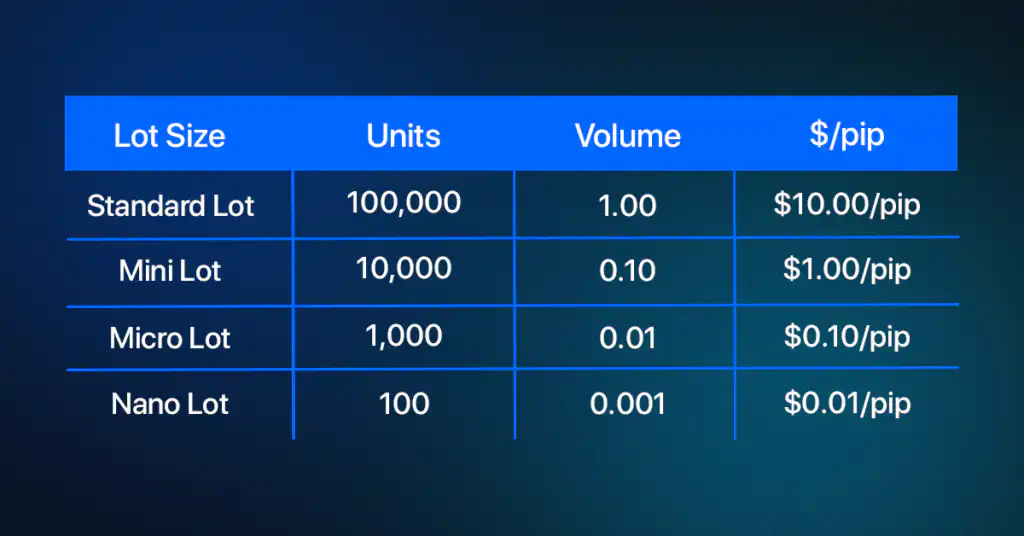
There’s an exact formula to calculate your position size based on your Stop Loss size in pips, but that’s far too complex and takes time. It’s way more efficient to just use an online position size calculator, like MyFXBook’s one here.
4. Diversified Trading Approach
You might be great in trending markets, but how good can you handle consolidating conditions?
Having a different approach for different market conditions will save you a lot of trouble. Even if you don’t trade all conditions, you should at least be able to recognize them.
5. Regular Risk Assessments
There are probabilities even within High Probability market conditions. Assessing each case and adjusting your risk accordingly is an important trait a trader must acquire.
6. Monitoring Risk in Real Time
Sometimes, the market will present multiple opportunities on the same trading day.
It’s important to monitor your open risk and make adjustments when necessary, limiting your exposure and how much you can potentially lose within a day, across a few trades.
7. Understanding Market Seasonalities
As with everything, there are seasonalities in the financial markets as well. Some will be more favorable for your trading strategy, others not so much.
It’s important to recognize such shifts and adjust your risk accordingly, increasing or decreasing Risk Per Trade when necessary.
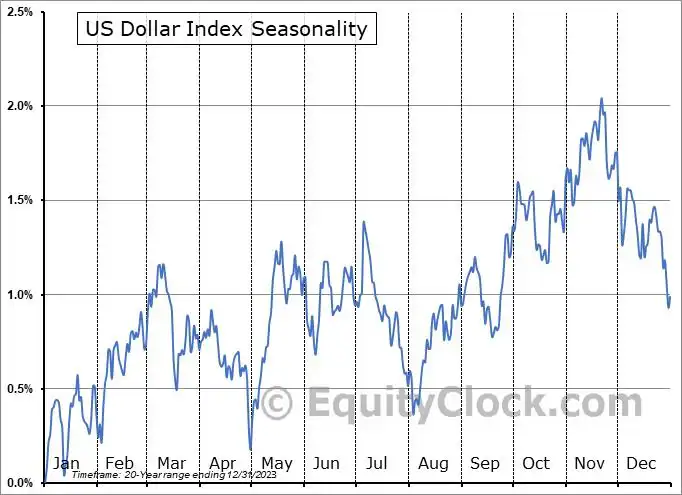
This is a 20-year range of the DXY’s (Dollar Index) seasonality. As seen on the line chart, August tends to begin a strong uptrend, which peaks in November, and forms a bottom in January.
8. Managing Emotions
Holding yourself accountable and managing emotions while in a trade is also part of Risk Management.
A lot of traders can end up over-risking and carrying emotions over to their trades, even forcing trades that don’t meet their trading strategy because they were emotional.
It’s important not to eliminate emotions; we’re all still human, but to manage and regulate them.
9. Using Risk Management Tools
Whenever possible, using trading tools can help make Risk Management easier.
Position sizing calculators can help eliminate any kind of calculations for your position sizing you’ll have to do by yourself manually.
10. Risk-to-Reward Ratio (RRR)
Using a favorable Risk-to-Reward Ratio is another aspect of Risk Management that’s often overlooked.
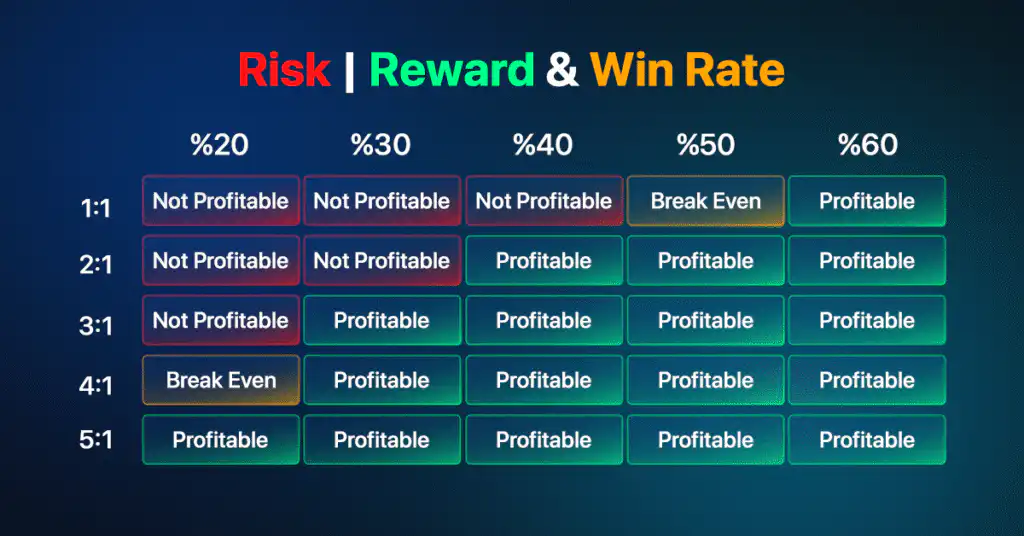
Statistically, the average win rate for retail traders tends to be between 30–50%. But because their losses are usually larger than their wins, they end up negative overall, adding up to the well-known statistic that 73.42% of retail investors lose money when trading CFDs specifically, as per IC Markets, the largest Forex broker in the world.
This is why having proper RRR and ensuring that when you win, you always win more than when you lose is crucial. A Risk-to-Reward Ratio of 2 is the least we recommend since you only need to be right 33% of the time to break even. Anything above a 33% Win Rate is profitable.
As you can see, Risk Management is far more complex than just “Risk per Trade”.
We now understand what it is, but let’s learn why Risk Management is important next.
Why is Risk Management Important?
Even the most profitable trading plan will fail without proper Risk Management.
A good trading strategy may help you take profitable trades, but Risk Management ensures that you stay in the game long enough to benefit from your trading strategy.
Statistically, with a Win Rate of 50% (which is a great Win Rate), you have a 97.1% probability of encountering a 6-trade losing streak.
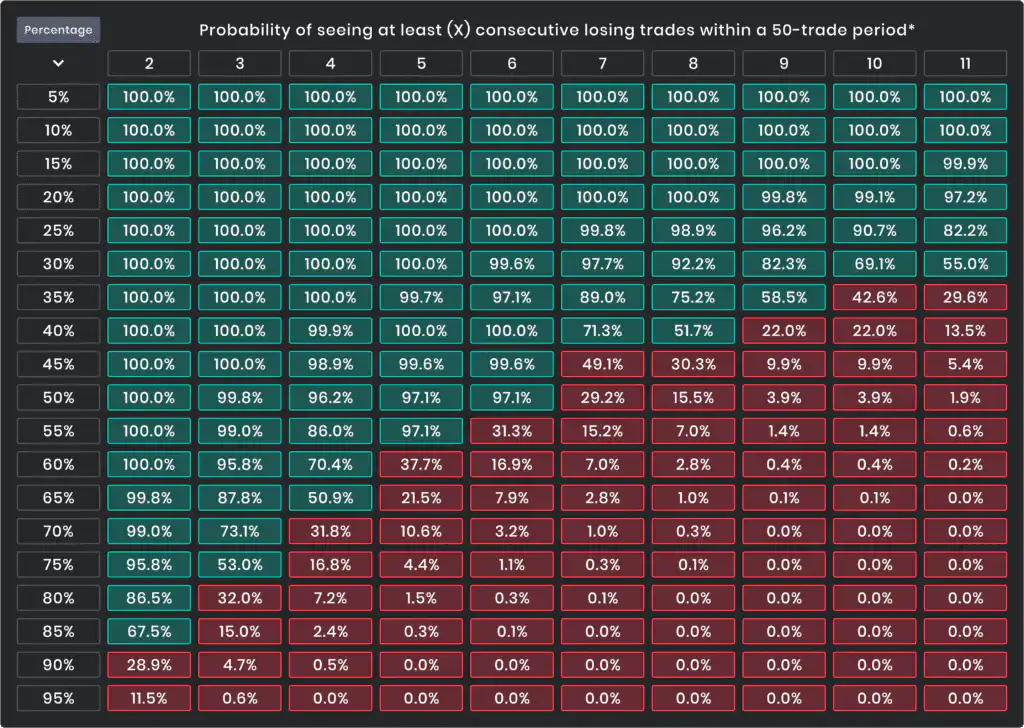
If you’re trading a personal account and risking 1% per trade, a 6% drawdown might not seem like a lot. You’re far from blowing your entire account and have a lot of room to work on recovering.
But when you’re limited to losing anywhere from 5% to 10% before blowing your entire prop firm account, things drastically change.
Standard Risk Management
A good starting percentage in Forex trading could be 2% risk per trade of your available capital.
If you have $100,000 in your personal account, with these parameters, your maximum loss would be $2,000 per trade.
A 2% loss per trade would mean you can be wrong 50 times in a row before you blow your account. This is an unlikely scenario if you have a proper trading plan and you’re stacking the odds in your favor by utilizing a good Risk-to-Reward Ratio.
Prop Firm Risk Management
Prop firms have very strict rules when it comes to Risk Management. This is both good and bad.
It’s good because you’re forced to learn amazing Risk Management, which can only help you in the long run, especially when you move to a personal or investor account.
It’s bad because you’re severely limited in terms of Risk Per Trade and how many trades you can afford to lose before blowing up your prop trading account.
Maximum and Daily Drawdown
All prop firms work with a Maximum and Daily Drawdown. If you’re unfamiliar with these terms, check out our full breakdown of every type of prop firm drawdown available here.
The Maximum Drawdown determines how many percent of your account you can lose in total, before you blow up and lose the entire prop firm account.
The Daily Drawdown determines how many percent of your account you can lose within a trading day, before you blow up and lose the account.
Similar to the personal account example, let’s say you are trading a $100,000 prop firm account.
Using the industry standard for Maximum and Daily Drawdown, you have a 10% Max. DD and 5% Daily DD to work with.
This means that you can lose $10,000 (Max. DD) in total before you lose your prop firm account, or $5,000 (Daily DD) in a trading day.
From a Maximum Drawdown perspective, risking 2% per trade means you can only afford to lose 5 trades in a row in total before your account is gone.
Risking 1% limits you to 10 losses in a row before your account hits the Max. DD limit. You could get away with 1% Risk Per Trade, given you have a Win Rate above 25%, but even then, it’s still going to be very close and risky.
Monte Carlo Trading Simulation
A Monte Carlo simulation is a method of modeling uncertainty by running a huge number of randomized trials to see the range of possible outcomes.
We ran multiple Monte Carlo simulations for this Forex purpose with the following metrics:
- A Risk-to-Reward Ratio of 2
- 1% Risk Per Trade
- 50% Win Rate
Over a number of 100 trades, we still encountered multiple occasions where there were 8 consecutive losing trades, and over 9.5% drawdown.
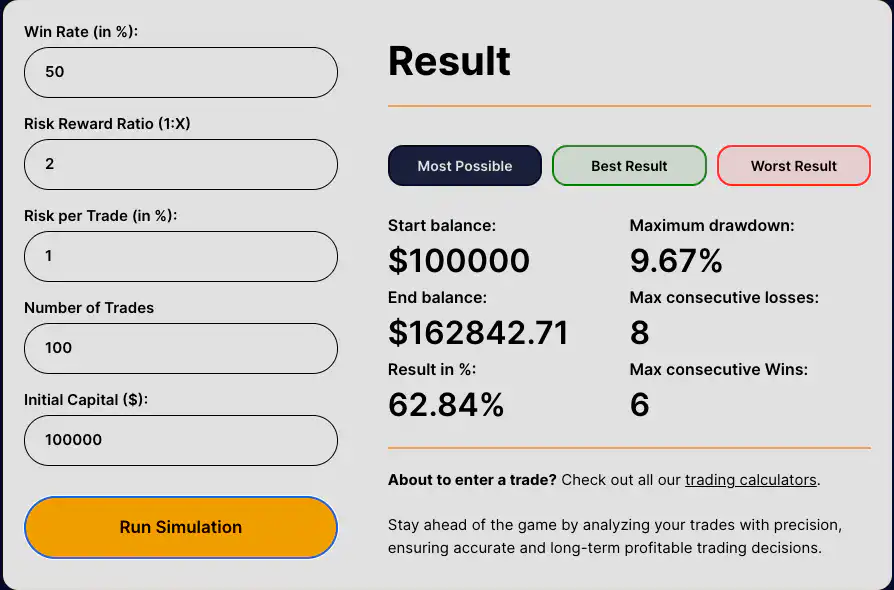
This is too close to the 10% Drawdown prop firms impose, and the Drawdown and consecutive losses increase as the Win Rate goes down, even if it’s just by a few percent.
If you want to run the simulations yourself, you can find the Market-Bulls tool here.
Prop Firm Risk Management Cheat Sheet
We recommend a different approach when it comes to the strict Risk Management rules you’ll encounter when trading prop firms.
There are two different scenarios that will determine your Risk Management profile, depending on your goals and financial situation.
Calm Approach
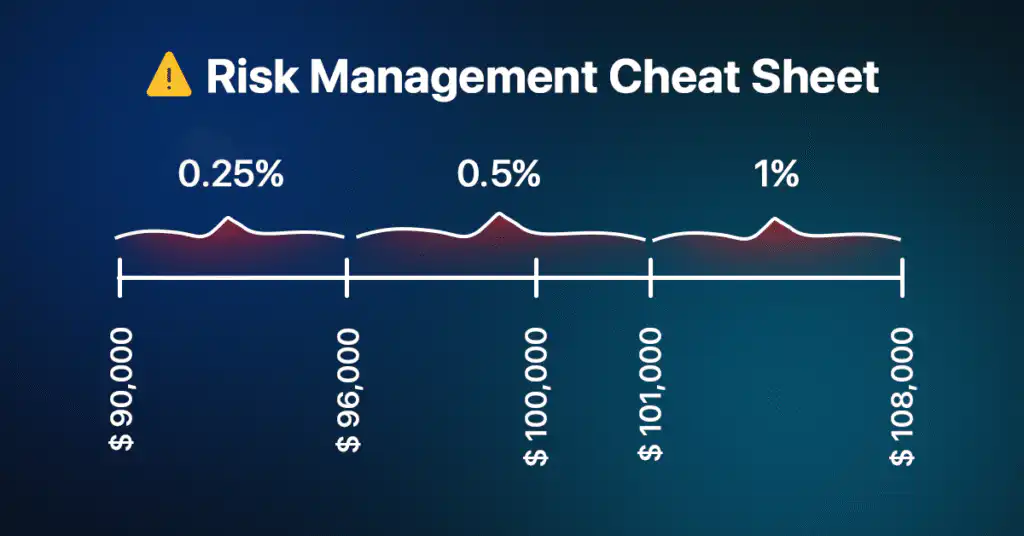
This is what we usually recommend going with if you can’t afford to lose multiple prop firm evaluations before finally passing and getting a funded account.
If you want to keep your account for as long as possible and minimize the chances of ever blowing it, this approach is for you.
You’ll work with brackets, where if:
- You will risk 0.5% per trade while you’re at your starting balance
- You’ll risk 0.5% anywhere from $96,000 to $100,000 (so within 4% drawdown)
- You’ll risk 0.25% per trade if you drop below $96,000 (more than 4% drawdown)
- You’ll risk 1% per trade if you get your balance to $101,000 or higher.
This leaves you with the following brackets:
[Account balance < $96,000] = 0.25% risk per trade
[Account balance between $96,000 – $100,000] = 0.5% risk per trade
[Account balance ≥ $101,000] = 1% risk per trade
Aggressive Approach
This is only if you can afford to be blowing at least one or multiple prop firm evaluations per month, without it affecting your financial situation.
Risk 2% per trade with this approach. If you can avoid the 5-trade losing streak long enough, you’ll only need 4 winning trades to hit your Phase 1 Profit Target and 2.5 trades to pass Phase 2.
This will ensure you take the least amount of time to get to the funded stage in your prop firm. By no means do we recommend keeping this approach once you’re funded.
It’s advisable to switch back to the Calm Approach once you’ve passed your challenge.
FAQs
- How much should I risk in prop firms?
Anywhere from 0.25% to 1% risk per trade is fine for prop firms.
- What’s the best Risk to Reward Ratio?
Ideally, a Risk to Reward Ratio of 2R or 3R.
- Can I avoid losing streaks in trading?
Losing streaks are inevitable and part of trading. Rather than avoiding, traders should work on managing and surviving them.
- What’s a good win rate in Forex trading?
40% to 50% is a great Win Rate, especially with a Risk to Reward Ratio of 2 or 3.
- How to calculate lot size in Forex?
To calculate your position size, we recommend using online position size calculators. While it can be done manually, there’s virtually no point in making it harder.