

Trading isn’t just about getting the perfect entry or exit. If it were that simple, we’d all be rich. The real secret, the thing that separates professional traders from retail traders, who blow up their accounts, is money management.
It’s the boring part of trading that actually keeps you in the game long enough to win.
Why Most Traders Fail (And How You Won’t)

Most people who try trading are going to fail, the statistics confirm it. It’s not because their strategy is terrible or they can’t spot a trend. They fail because they have absolutely no plan to protect their capital.
We’re going to drill down into the nuts and bolts of smart money management. Stop chasing that one massive win and start obsessing over keeping what you have. This single change is the first step toward treating trading professionally.
In the markets, a solid defense is your best offense. You need a practical framework to manage every single dollar in your account.
Trading Without a Plan
It’s way too easy to get swept up in the heat of the moment. You see a setup, your heart starts pounding, and you throw your rules out the window. But letting emotions drive your decisions can lead to a few bad trades, fueled by greed or fear, erasing weeks of hard-earned gains.
Studies have consistently shown that over 90% of traders lose money and quit within their first year. Why? It almost always comes down to terrible risk management.
The goal of a successful trader is to make the best trades. Money is secondary. – Alexander Elder
Most professional traders risk only 1-2% of their total capital on any single trade. When your focus shifts from making money to protecting your capital, the profits tend to take care of themselves.
Your number one job isn’t to get rich quick, it’s to stay in the game.
Building a Foundation for Long-Term Success
A solid money management system is what gives you the structure to weather the inevitable drawdowns you are certainly going to experience in your trading. It guarantees that one bad trade, or even a losing streak of them, can’t take you out completely.
Here’s what a proper framework really does for you:
- Takes Emotion Out of It: It replaces gut feelings, fear, and greed with a simple, mechanical process. You just follow the plan.
- Guarantees Longevity: It keeps your account healthy so you’re still standing and ready to execute on the next A+ setup after a drawdown.
- Forces Discipline: It makes you treat trading like the serious business it is, not a get-rich-quick scheme.
By mastering the principles we’re about to cover, you’ll have the tools to manage your funds like a professional trader does. This foundation is what will allow you to survive, learn, and eventually thrive.
Creating Your Personal Risk Management Rules
Good money management begins with building a set of hard, non-negotiable rules that protect you when greed and fear inevitably show up.
You have to create these rules before even getting into your first trade.
Having the numbers defined ahead of time takes the guesswork out of high-pressure situations. It’s what prevents one bad day from spiraling out of control and wiping out weeks of hard-earned progress. This is about building a system that protects you from your own worst instincts.
The Famous 1% Rule: Your First Line of Defense
If you only follow one rule, make it this one. The most critical rule in any trader’s playbook is capping your maximum risk on any single trade.
The undisputed industry standard is the 1% rule. This principle is simple: you should never risk more than 1% of your total account balance on one trading idea.
For a $10,000 account, your maximum acceptable loss on a single trade is just $100. It doesn’t matter how perfect the setup looks or how confident you feel. Very advanced traders know when to increase risk per trade, but most still never go over 2% per trade.
Capping how much you can lose in one single trade ensures that a losing streak, which is guaranteed to happen, won’t destroy your account. You can be wrong 10 times in a row and still have 90% of your starting capital left to trade with.
This is the exact discipline and money management that prop firms want to see in their traders, which will help you pass prop firm challenges. Preserving capital always comes before profits.
Defining Your Daily and Total Loss Limits
Beyond risk per trade, you need two more critical details figured out: a daily loss limit and a maximum drawdown. These are the numbers that tell you when to stop trading for the day or force you to completely re-evaluate your strategy.
Think of them as your ultimate safety nets.
- Daily Loss Limit: This is the absolute maximum you’re willing to lose in a single day. A common limit is 3-5% of your account balance, which is also what most prop firms enforce. The moment you hit this number, you should close your charts and walk away. This is a great tool for preventing “revenge trading,” where you chase losses by trying to make up for them with forced trades, spiraling into a vicious cycle.
- Maximum Drawdown: This is the biggest hit your account can take from its peak value before you stop trading live money entirely. A typical max drawdown is between 10% and 20%. Hitting this limit means something is fundamentally broken with your strategy or your execution. It’s a signal to go back to a demo account and fix it.
Your job is to protect your capital. Your strategy’s job is to grow it. Never get those two confused. Predefined loss limits ensure you always prioritize capital preservation above all else.
Putting It All Together: A Practical Look
So, what does this look like in the real world? The table below lays out some practical examples for different account sizes, helping you visualize exactly what your own limits should be.
Sample Risk Management Rules for Different Account Sizes
| Account Size | Max Risk Per Trade (1%) | Max Daily Loss Limit (3%) | Max Drawdown (15%) |
|---|---|---|---|
| $5,000 | $50 | $150 | $750 |
| $10,000 | $100 | $300 | $1,500 |
| $25,000 | $250 | $750 | $3,750 |
| $50,000 | $500 | $1,500 | $7,500 |
Seeing the numbers laid out like this makes it crystal clear. A trader with a $25,000 account knows that if they lose $750 in a day, they’re done. No more trades until tomorrow.
This structured approach removes emotion and guesswork, replacing them with objective numbers that keep you solvent and ready for the next opportunity.
How to Calculate Position Size
Once you’ve got your risk rules defined, you have to put those rules into action on every single trade. This is where position sizing comes in, which is one of the most critical skills in your entire money management toolbox.
Position sizing is just the simple math that turns your “1% risk” rule into a concrete number of shares, contracts, or lots to trade. It guarantees your risk is exactly what you intended it to be, before you hit the buy or sell button.
The Universal Position Sizing Formula
The good news is that in today’s modern digital trading, position sizing is easier as ever. You no longer need to do any math manually, and most trading platforms calculate everything for you. All you need to know is the percentage you want to risk per trade, based on your trade idea.
Knowing the core formula won’t hurt, however. It’s very simple and works regardless of the market you’re trading. Stocks, Forex, Crypto, the logic is always the same.
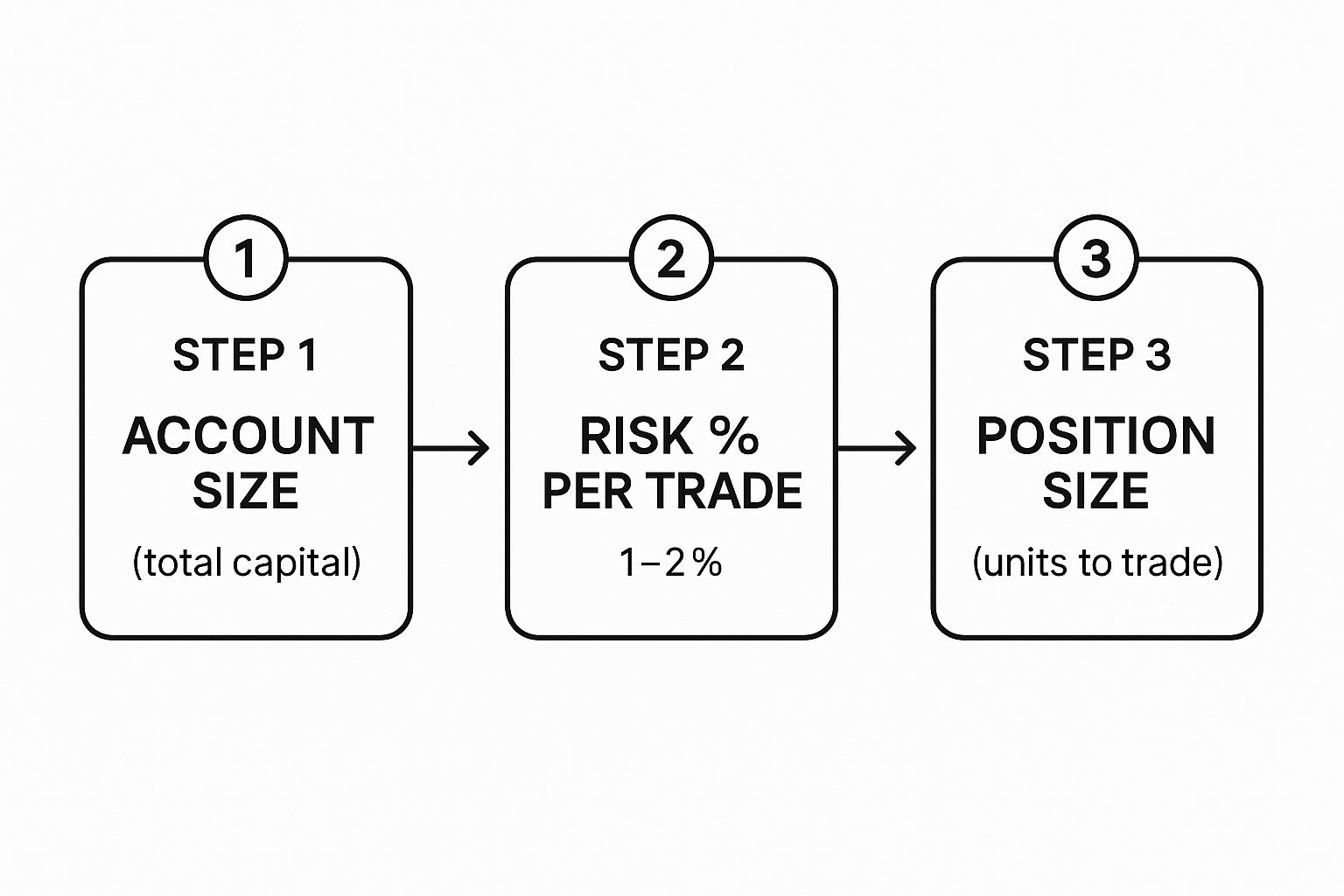
You just need three key pieces of information to figure out your exact trade size:
Position Size = (Total Capital x Risk %) / (Entry Price – Stop Loss Price)
Let’s break that down. You’re taking your maximum risk in dollars (say, $100 on a $10,000 account) and dividing it by the distance in price between where you get in and where you get out if you’re wrong (your stop-loss). The answer tells you exactly how much of that asset you can trade while staying inside your risk limit.
Putting the Formula into Action
Let’s walk through a quick, real-world example to see how this plays out.
Imagine you’re working with a $20,000 trading account and you’ve committed to the 1% rule. That means your absolute maximum risk on any single trade is $200.
You spot a potential long setup on stock XYZ. Your plan is to enter at $50.00 and place your protective stop-loss at $48.00. The difference between your entry and your stop is $2.00 per share.
Now, just plug those numbers into the formula:
- Position Size = ($20,000 x 1%) / ($50.00 – $48.00)
- Position Size = $200 / $2.00
- Position Size = 100 shares
That’s it. To keep your risk at exactly $200, with this size of a stop-loss, you can buy 100 shares of XYZ. If the trade turns south and hits your stop, you will lose exactly what you planned for.
Adapting Position Sizing for Different Markets
The formula for position sizing is universal, but the “units” you’re calculating will change. The core idea of dividing your max dollar risk by your per-unit risk is constant.
- Forex Trading: In Forex, your risk per unit is measured in pips. Your calculation will tell you how many lots (standard, mini, or micro) to trade. If your $200 risk works out to a 20-pip stop on EUR/USD, your position size might be one standard lot.
- Futures Trading: For futures, risk is all about the “tick value.” If a one-point move in an E-mini S&P 500 contract is worth $50 and your stop is 4 points away, your risk per contract is $200. In that case, your position size is simple: one contract.
- Cryptocurrency: Trading Bitcoin follows the same principle. If you’re risking $200 and your stop-loss on BTC is $500 below your entry price, your position size would be 0.4 BTC ($200 / $500).
The instrument doesn’t matter. The math that protects your capital is always the same.
Beginning traders think about how much money they can make, but professionals think about how much they can lose.
Growing Your Capital
Once you know how to protect your capital, you need to start growing it.
Professional traders view things from a different perspective. They are constantly analyzing how much they stand to gain, making sure every single trade they take is actually worth the risk. This is where risk/reward ratio comes in.
Prioritizing Favorable Risk-to-Reward Ratios
The absolute cornerstone of a strong trading strategy is the risk-to-reward ratio. It’s a simple idea: you’re just comparing how much you’re risking (the distance from your entry to your stop-loss) against how much you expect to make (the distance to your take-profit).
As a general rule, you should only consider trades where the potential reward is at least double your potential loss. We call this a 1:2 risk-to-reward ratio.
Why is this important? It gives you a massive statistical edge. Think about it: with a 1:2 ratio, you only need to be right about a third of the time just to break even. Any win rate higher than 33%, and you’re officially profitable.
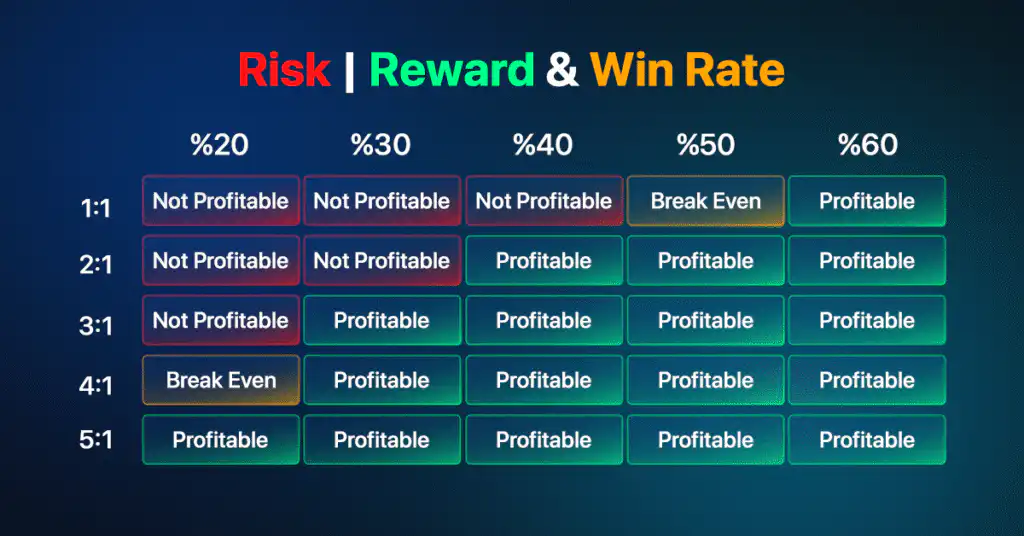
This creates a powerful buffer that can carry you through those inevitable losing streaks. You don’t have to be perfect to make money, you just have to be disciplined.
Identifying Logical Profit Targets
A fantastic risk-to-reward ratio includes a logical take-profit target as well. You need to identify high-probability zones where the price is likely to react.
Here are a few proven ways to set realistic profit targets:
- Key Liquidity Levels: I always look for significant highs and lows. These are the spots where we likely have a lot of liquidity residing, and they act like magnets for price.
- Fair Value Gaps: Gaps in fair value, where one side of market participants couldn’t get involved, are a great magnet for price.
The goal is to pick a target that makes the trade worthwhile without being completely unrealistic. This skill becomes especially important when you’re trading prop firm challenges, where you have to hit a specific profit target.
Once you’re in a trade, your job is to maximize its potential while methodically eliminating your risk.
The Art of Scaling Out of Winners
One of the most effective techniques for active trade management is scaling out of a winning position. Instead of closing your entire trade at one specific target, you sell off pieces of it as the market moves in your favor.
This does two things at once. First, it lets you lock in guaranteed profits, which takes a huge psychological weight off your shoulders. Second, it allows you to turn a good trade into a risk-free trade.
Here’s a practical example of how this works:
- Enter the Trade: You buy 100 shares of a stock, risking $1 per share. Your total risk is $100.
- Take Partial Profits: Your first target is at a 1:1 risk-to-reward ratio ($1 of profit per share). When the price hits it, you sell half your position (50 shares) and instantly book a $50 profit.
- Create a Risk-Free Trade: Right after selling, you move the stop-loss on your remaining 50 shares up to your original entry price.
The worst that can happen now is price reversing and stopping you out for breakeven on that second half. But you still keep the $50 you already banked. The rest of the trade is now 100% risk-free, with unlimited upside potential if the trend keeps running. It’s a powerful money management technique that lets you pay yourself while still aiming for that home run.
Use a Trading Journal to Stay Disciplined
Your risk rules and position sizing formulas are the blueprint. But a blueprint is just a piece of paper if you don’t follow it. This is where a trading journal comes in.
Forget thinking of it as just a log of wins and losses. A journal is your ultimate accountability partner, the one thing that will force you to be brutally honest with yourself about your trading.
It’s where you document not just the numbers, but the story behind every single trade. Over time, this data becomes a roadmap, showing you exactly where your habits are helping or hurting your P&L.
What to Track Beyond Profits and Losses
A good journal goes deep. Only recording your profit and loss is like trying to understand a football game by looking at the final score. You miss all the crucial plays that actually decided the winner.
To get any real value, you have to track the context and your own behavior. This is the data that will turn your money management plan from theory into a disciplined, everyday practice.
Here are the essentials you need to log for every trade:
- Trade Rationale: Why did you take this trade? What was the specific technical or fundamental reason that made you pull the trigger?
- Emotional State: How were you feeling? Calm? Greedy? Scared? Impatient? Be brutally honest here, it’s critical.
- Rule Adherence: Did you stick to your plan? Note any deviation, like moving your stop-loss mid-trade or taking profits way too early.
- Screenshots: A picture is worth a thousand words. Snap a shot of your charts at entry and exit so you can review the setup visually later.
This level of detail forces a pause, a moment of reflection before and after you act. It’s the perfect way to short-circuit those impulsive, gut-based decisions that kill accounts.
Regularly analyzing this information is how you turn raw data into actionable insights. It’s the key to becoming a more self-aware and consistently disciplined trader.
Turning Data into Discipline
After just a couple of weeks, your journal will start revealing patterns you never would have noticed otherwise. This is where the real work begins.
Set aside time every single weekend to review your trades. Look for recurring themes in both your wins and your losses.
Maybe you’ll discover a clear pattern: you consistently over-risk after a big winning day, giving all those hard-earned profits right back. Or perhaps you have a bad habit of cutting winning trades short out of fear, which completely skews your risk-to-reward ratio.
Once you spot a weakness, you can create a specific rule to fix it. If you’re a profit-cutter, your new rule might be, “I will not close a trade before it hits my initial target or my trailing stop is triggered.”
This feedback loop of trade -> record -> review -> improve is the only way to grow. It’s how you systematically plug the leaks in your trading strategy and build the discipline needed to make your money management plan work. Without it, the best rules are just suggestions.
Adapting Your Strategy Long Term
The market is constantly shifting, and what worked last month might change next month. This is why a “set and forget” money management plan is a fantasy. Your strategy has to be as dynamic as the markets you trade.
Building a real career in this game comes down to one thing: your ability to adapt.
A strategy that worked in a quiet, trending market will get chewed up and spit out when volatility spikes. Your risk parameters can’t be set in stone. The goal is to build a system that bends without breaking, keeping you in the game no matter what the market throws at you.
Evolving with Market Conditions
When volatility dries up and the market is barely moving, your usual stop-loss might be way too wide. This forces you into tiny position sizes that make even winning trades feel pointless. In these quiet periods, it might be smart to tighten things up a bit or adjust your risk-reward targets.
On the flip side, when fear takes over and the market is swinging wildly, sticking to those old tight stops is a recipe for getting stopped out repeatedly. That’s when you need to give your trades more room to breathe. Widen your stops, which naturally forces you to reduce your position size and cut your risk. It’s all about surviving the storm so you can be there to capitalize on the opportunities that always follow.
Treat Your Trading Like a Business
The final, and maybe most important, piece of the puzzle is a mental shift. Stop thinking like a gambler looking for a big score. Start thinking like the CEO of a small business, and your trading capital is your inventory.
Your number one job isn’t to make money. It’s to protect what you have. Profitability is just the byproduct of excellent risk management.
This means you show up every single day, follow your business plan (your trading rules), and focus on consistent execution. The outcome of one trade is irrelevant. It’s your ability to manage risk over hundreds, even thousands, of trades that determines if you’ll make it.
FAQ
- How much of my account should I risk on one trade?
The safest place to start is the 1% rule. Never risk more than 1% of your total account balance on any single trade.
If you have a $10,000 account, that means your maximum acceptable loss for a trade is $100. It’s what keeps you in the game long enough to win, even when you hit an inevitable losing streak.
- What’s a good risk-to-reward ratio?
You should be looking for trades where your potential upside is at least double your potential downside. We call this a 1:2 risk-to-reward ratio.
Sticking to a positive risk-to-reward ratio is how you gain a statistical edge. It literally means you can be wrong more often than you’re right and still come out profitable in the long run.
This builds a crucial buffer against losses and is how professional traders manage their money. It can completely change your long-term results and give you real financial stability in the markets.