
You’re Leaving Money on the Table
Prop firms are funding traders with $100,000+ accounts — without them risking their own capital. If you’re still stuck trying to grow a $500 account in 2025, you’re leaving serious money on the table.
The barrier to entry in trading has changed, and it’s easier than ever to scale your capital now that prop firms are available and traders are getting funded with them. Why aren’t you?
Key Takeaways
- Prop firms let you trade $100,000 of capital for just $500, much less if you use PipBack’s discounts offer.
- Before you can start trading with a large capital, you need to pass the prop firm’s challenge phases.
- Traders can participate in a wide range of markets, such as Forex, crypto, and stocks, with a prop firm account.
What is Prop Firm Trading?
Prop Firms (also known as Proprietary Trading Firms) are companies that give you capital to trade with under specific rules, in exchange for a payment.
You don’t risk your own capital, you trade theirs. And they usually work with a profit split of 80:20, so you get to keep a big portion of your profits.
But first, you usually have to pass an evaluation or challenge, where you must follow all rules, before getting access to the funded capital.
Things You Should Know Before Buying a Prop Firm Challenge:
-
Challenge Phases & Types of Challenges
The industry standard evaluation has 2 challenge phases. You must pass both in order to get funded.
Some firms offer 1-phase challenges or instant funding where you don’t have to pass an evaluation first, but the profit and drawdown rules are much less favorable, as well as the prices.
-
Profit Targets & Drawdown Rules
Prop firms have Maximum Drawdown and Daily Drawdown, as well as Profit Targets:
- Maximum Drawdown: A % of your account that you can lose in total, before losing the account itself.
- Daily Drawdown: A % of your account that you can lose in a day, before losing the account. This resets every day at 00:00 UTC.
- Profit Target: A % of profits that you’re required to make in order to pass the evaluation. This is usually 8-10% in Phase 1 and 5% in Phase 2.
-
Strict Rules & Restrictions
You will have to adhere to certain risk management and trading rules. Trading prop firms is not gambling, and firms often ban traders who approach it like that.
Below are the common prop firm rules you will encounter:
- Profit Target: The primary rule to target is the profit target of around 6% to 10%. Not only is this required to pass all challenge steps or phases, but also for all active accounts.
- Drawdown Limit: Another rule to focus on apart from your profit target is your drawdown limit, which is how much an account can lose. Most firms have a daily drawdown and an overall drawdown.
- Trading Days: Almost all challenge steps require a minimum number of trading days, which is around 2 to 3 days. While there are no maximum trading days, all prop firms have an inactivity rule. If you have not logged into your account and made zero trades for 30 consecutive days, you risk breaking the inactivity rule.
- News Trading: This rule is about making trades around significant news affecting the stock, forex, or futures markets. Certain firms allow it, but have strict guidelines regarding news trading. If you plan on trading the news, check on your prop firm’s rules before doing so.
- Gambling Behavior: Prop firms discourage activities that act like gambling. This includes excessive trading volume within a short period or random position entries.
-
Know Your Trading Style
Pick a prop firm that has the right leverage, spreads, and commissions for your trading style. There are prop firms that favor day traders, swing traders, or scalpers.
Make the right choice before spending money on challenges. Here is a detailed look at each trading style:
- Scalping: Traders utilize a scalping strategy to profit from small price movements during a short time period. This style requires extreme discipline and a solid trading plan to avoid large losses.
- Day Trading: Intraday trading or day trading involves buying and selling assets within the same trading day. This is a slightly longer method than scalping, but prices can still move just as fast within the short trading hours.
- Swing Trading: This involves buying and holding assets for a few days. The idea is to take a position with the expectation that markets are about to move upward. Always check on prop firms rules on overnight trading to know if you can use this style.
Note that we did not cover position trading, which involves holding a position for months or years. This type of trading is not recommended since prop firms have an inactivity rule.
-
Not All Prop Firms Are The Same
Prop firms are oriented toward the type of market you are trading, not just the type of trader you are. There are 3 types of prop firms:
- CFD Prop Firms: These prop firms allow you to trade CFDs (Contract for Differences) in Forex, Commodities, Indexes, and some Crypto pairs. Their platforms of choice are usually MetaTrader, cTrader, DXTrade, and MatchTrade.
- Futures Prop Firms: Futures firms are heavily regulated and considered safer than CFD prop firms. Instead of trading CFDs, you are trading the underlying Futures contract on the official CME charts. Futures firms have very different trading rules compared to CFD and Crypto prop firms. They are also traded through different trading platforms, which are usually TradeStation, Tradovate, NinjaTrader, and directly through TradingView.
- Crypto Prop Firms: These prop firms are similar to CFD prop firms, but are fully oriented toward trading the Crypto market. They offer a variety of trading platforms or have their own trading platforms built-in.
Why Is Prop Firm Trading the Fastest Way to Make Profits in 2025
You are missing out on a lot of potential profits if you’re trying to grow your $500 brokerage account forever instead of trading with prop firms.
You’re much better off purchasing a prop firm challenge for the same price. With just $500, you can get up to $100,000 of prop firm capital. Suddenly, 1% profit is no longer $50, it’s $1000.

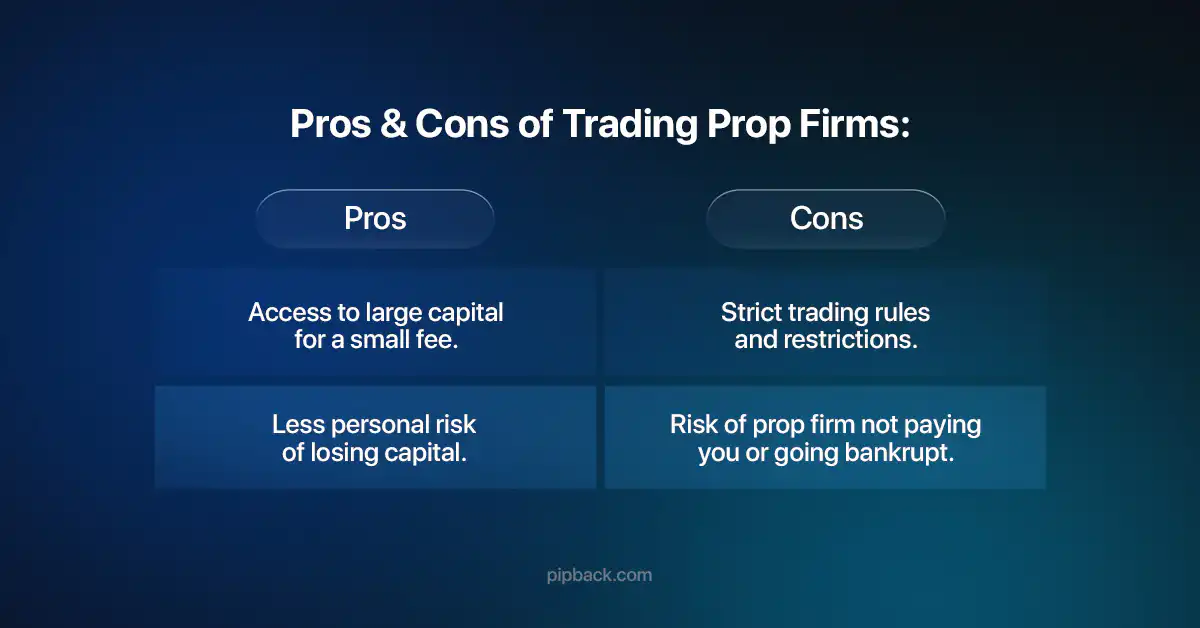
Pros & Cons of Trading Prop Firms:
Below is a quick list on the advantages and disadvantages of trading through a prop firm.
How to choose a prop firm?
Choosing a prop firm should be done carefully. Since their inception, hundreds of prop firms have been launched due to the low barrier of entry in this business.
Not all prop firms are trustworthy and reliable. There have been many cases of payout denials for no legitimate reason, prop firms going bankrupt, or just disappearing without paying their traders.
We saw 3 of the biggest prop firms go down at the end of 2023 and in 2024 alone: My Forex Funds, True Forex Funds, and Funded Engineer. Tens of smaller firms have followed suit afterward, which makes choosing the right prop firm crucial.
Here are our tips when it comes to prop firm trading:
-
Stick to the well-known firms, which have been here the longest
Prop firms like FTMO & The 5ers have been around for almost 10 years now. They have been operating without any issues and have proven themselves to be reliable.
You’ll always hear the occasional story of some unhappy trader, but the bottom line is, stick to companies that have been around for at least a few years.
They know what they are selling and offering, so their prices will be on the higher end, but we’ve got you covered.
-
Pay attention to online reviews and suspicious behavior
A lot of firms will start making up random rules and reasons to deny your payout. This is the first red flag that a prop firm doesn’t have its business in check, and your sign to stay away from it.
It’s in a prop firm’s interest to keep good traders and offer them great trading conditions.
If you’re profitable, the firm is getting a profit split from your payouts and can eventually A-book you (copy your trades) to make even more profits from you.
No legitimate firm will ban a trader for being “too profitable”, given that he’s applying good risk management and is not gambling.
Sooner or later, suspicious behavior becomes public, and traders start talking about it. Keep an eye on the prop firm’s social media channels.
-
Start small, don’t go all in
If you’ve never traded prop firms, you’re likely going to need some time to adjust to their trading rules and restrictions. You might end up hitting the drawdown or unintentionally breaching some of the rules.
Don’t start with the largest and most expensive evaluation account. Pick an account with a fee that you can afford to lose without it impacting your monthly finances.
-
Always look for discounts for your prop firm of choice
Even if prop firms allow you to leverage a large funded account in exchange for a small fee, you might end up breaching a few accounts before reaching that funded stage. Or you just want to purchase multiple evaluations.
Either way, we at PipBack have got your back.
How to get the best prop firm deals?
You might as well really make the most out of your money if you’re going to be leveraging prop firm capital.
We’re partnered with most of the major prop firms and offer you the highest discounts available in the space for FREE.
FAQ: Prop Trading Guide
Can I hold my positions over the weekend?
Various prop firms usually prohibit traders from holding positions that would last across a weekend. The restriction is a means of protecting traders from sudden price gaps or movements due to major events occuring while the market is closed.
Can I copy other people’s trades?
Copy trading involves taking a similar position with the same size as other accounts. Various firms have their policies on copy trading, with some allowing it when it involves accounts you own. Many do not allow traders to copy others or the market movement of accounts owned by someone else.
What are trailing drawdowns?
This is a rule for instant funding accounts, where the drawdown limit adjusts to the profit you make. The restriction makes instant funding much stricter than accounts going through challenge phases, since those deal with static drawdown limits.
Can I use expert advisors on my account?
Expert advisors (EAs) are software that uses complex algorithms to analyze the market and provide recommendations on where to open your positions. Most prop firms allow you to use your EA on your account as long as they comply with their rules. This includes not taking positions on your behalf or using them with high-frequency trading.
What is instant funding?
Instant funding is an offering where you get funding without going through the common evaluation phase. In exchange, the profit split and capital being exchanged is much less than those of a past account.