

If you want to get funded as a trader, you first have to pass an evaluation from a prop firm. It’s their way of making sure you can actually make money while playing by their risk management rules.
Think of it less as a test and more as a strategic partnership where they front the cash, and you bring the skill.
What It Really Means to Be a Funded Trader

Becoming a funded trader is a complete mental shift. It’s not just about getting your hands on capital. You’re stepping into the role of a professional money manager.
Your number one job is protecting the firm’s capital. Your second job is executing your strategy to grow it.
Thanks to prop firms, the dream of trading a six or even seven-figure account has become a reality. The prop firm model is a massive game-changer because it smashes the biggest wall that most talented traders hit: not having enough of their own money.
Instead of sweating over your personal savings with every trade, you prove you can trade profitably in a challenge environment. If you’re successful, the firm hands you the keys to its capital, and from there, you just split the profits.
From Trading Pits to Online Challenges
Let’s dive into the history of prop firms a bit. Prop firms have been around since the 90s, but back then, they were exclusive clubs on physical trading floors, headhunting elite traders.
The internet blew the doors wide open. Now, anyone with a solid strategy and a bit of discipline can take a shot at getting funded, no matter where they are in the world.
This modern approach uses an evaluation, or “challenge” process. While they’re accessible to everyone, don’t mistake that for being easy.
Historically, the success rates have been pretty tight. It’s estimated that only about 10-20% of traders who try actually pass and get funded, and even fewer get to consistent prop firm payouts.
Understanding Prop Firm Rules
Before you dive in, you need to understand the basic structure. The firm sets the rules, and you have to show you can play within those boundaries.
You’ll almost always run into these key components:
- Evaluation Stages: Most firms put you through a one or two-phase challenge to see how you perform under pressure.
- Profit Targets: You’ll need to hit a specific profit goal, usually somewhere between 8% and 12%, to prove your strategy works.
- Drawdown Rules: These are the hard-and-fast risk limits. If you breach the daily or maximum loss limit, you’re out.
- Trading Period: Challenges used to have strict time limits, like 30 or 60 days, but thankfully, this is history, and firms no longer impose a time limit for passing an evaluation.
The bottom line is, prop firms aren’t looking for gamblers who hit the occasional home run. They want disciplined partners who can perform consistently. They need to see that you can follow rules and manage their money responsibly over the long term.
Understanding the game is how you build the right mindset to beat the challenges and join the ranks of funded traders doing this for a living.
Choosing the Right Prop Firm for Your Strategy
Finding the right prop firm is a lot like picking a business partner. The big, flashy profit split numbers always grab your attention, but that’s often not the best approach.
It’s critical to look past the marketing hype.
To become a funded prop firm trader, you need a firm whose rules line up perfectly with your personal trading style. A firm built for a scalper might be a complete nightmare for a swing trader.
The whole game is about matching their evaluation structure and risk rules to how you actually trade.
Understanding the Evaluation
The first thing you’ll run into is the evaluation model. Most firms fall into one of two camps: one-step or two-step challenges.
The traditional two-step challenge usually has a lower profit target for each phase, but you have to prove your consistency over a longer period.
On the other hand, a one-step challenge can get you a funded account much faster and is a solid option for aggressive traders who are confident in their edge, but it almost always comes with tighter risk limits.
By far, the most critical rule to understand is the drawdown:
- A static drawdown is a fixed percentage of your starting balance; it never moves.
- A trailing drawdown, however, follows your account’s highest point, which can feel like a constantly shrinking safety net if you’re not careful.
Your trading plan is the foundation for navigating all these complex rules.
Finding the Right Prop Firm for Your Trading Style
Imagine you’re a news trader. You absolutely need a firm that allows trading during major economic events and doesn’t have ridiculous rules, slippage or slow execution speed. Some firms completely ban news trading during their evaluations, which makes them an instant “no” for you.
Or maybe you’re a swing trader who holds positions overnight or over the weekend. You’ll have to look for a firm that explicitly allows this and has swap-free accounts as well.
Many firms force you to close all trades by Friday afternoon or at the end of every trading day, which would completely cripple a swing trading approach.
Comparing Prop Firm Evaluation Models
To make this clearer, let’s compare a few hypothetical firms. Each one is designed for a different type of trader, and seeing the rules side-by-side really highlights how important it is to find the right fit for your specific strategy.
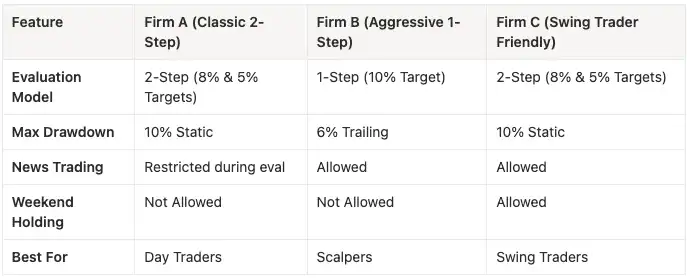
As you can see, a scalper would likely fail Firm C’s longer evaluation, while a swing trader wouldn’t even be able to execute their strategy with Firm A or B. The details matter a lot.
Reputation and Payout Consistency
Finally, don’t get so caught up in the rules that you forget to vet the firm’s reputation. A perfect set of rules means absolutely nothing if the company is unreliable or plays games when it’s time to pay you.
Dig around for authentic reviews on sites like TrustPilot, check their presence in trading communities on Discord or Telegram, and find out how consistent their payouts really are. A strong community and transparent communication are usually good signs that you’re dealing with a trustworthy partner.
Passing the Challenge
The challenge is the final gatekeeper, built to test your discipline, risk management, and ability to stay profitable under pressure.
Don’t mistake passing a challenge by hitting a few home runs for skill, however. It’s about proving you can operate like a professional money manager.

First things first: you need a trading plan that will fit the firm’s rules. Don’t just trade your usual strategy, adapt it if needed.
If the firm has a 4% daily loss limit, your personal hard stop should be tighter and at most 0.5%, so you can give yourself enough losses before you blow up. That buffer gives you breathing room and stops one bad day from causing you to lose your entire challenge.
Psychology
Psychology can wreck even the most profitable trading plans. The pressure to hit a profit target, especially with a limited amount of drawdown, often leads to disastrous decisions like revenge trading or forcing setups that just aren’t there.
Your mental game is just as crucial as your technical one:
- Focus on process, not profits: Concentrate on executing your plan perfectly on every single trade. The profits will come as a byproduct of good discipline.
- Set daily goals: Instead of obsessing over the big profit target, aim for small, consistent wins. A goal of 0.5% a day feels way more manageable than staring down an 8% profit target.
- Know when to walk away: If you hit a few losses in a row, close the charts, take a break. Trying to “win it back” is the fastest way to fail an evaluation.
Mastering Risk After You Get Funded
Passing the evaluation is a huge milestone, but it’s not the final destination. The real marathon begins the moment you get that funded account. Your goal immediately shifts from hitting an aggressive profit target to one simple thing: protecting the firm’s capital.
This is where your professional risk management skills become everything. It’s the single biggest factor that separates a trader who gets a few payouts from one who builds a long-term career.
Your new trading environment is defined by a set of hard rules you absolutely cannot break. Respecting them is your top priority.
- Daily Drawdown Limit: This is the maximum you can lose in a single day before your account is gone.
- Maximum Drawdown Limit: It’s the overall loss limit, calculated from your starting balance, and breaching it will cost you your account as well.
From Evaluation Rules to Live Account Strategy
You have to adapt your approach. The high-risk, target-focused strategy that got you through the challenge is often way too aggressive for a live account. Now, it’s all about consistency and capital preservation.
This starts with getting your position sizing right every single time. You need a precise calculation based on your stop loss and the account’s drawdown rules.
Risking 1% of your account on a single trade is a common professional standard, but with a funded account, you might want to tighten that to 0.5%. This gives you more breathing room to navigate the drawdown limits and avoid any close calls.
The funded trader market is exploding, surging over 15% annually between 2018 and 2024. With data suggesting that 25%-30% of all U.S. retail trading volume flows through prop firms, their focus on strict risk control is what keeps them in business. Drawdown limits are often capped as low as 5% of total equity, which just shows how seriously they take risk management.
Scaling Your Way to a Seven-Figure Account
Most reputable firms offer scaling plans, and these are your ticket to managing a much larger account, sometimes well into seven figures.
If you consistently hit specific profit milestones, like 10% profit over a few months, without breaking any rules, the firm increases your account size. This is how you truly build wealth as a funded trader. It rewards discipline and proves you’re a reliable partner they can trust with more capital.
Smart Ways to Lower Your Trading Costs
Getting your hands on a funded account is a huge milestone, and the road to getting funded is paved with evaluation fees.
This is exactly where services built for the prop trading world make a massive difference. Platforms like PipBack are designed with one goal in mind: helping traders get exclusive discounts on those evaluation fees.
Think of it as another strategic tool in your trading arsenal, one that cuts down your initial risk before you’ve even placed a single trade.
FAQs
- Why do so many traders fail prop firm evaluations? It almost always boils down to one thing: terrible risk management.Traders get tunnel vision on the profit target and start taking oversized trades, hoping to get there in one go.This is exactly what leads them to smash through the daily or max drawdown limit and lose the challenge.The traders who make it simply prove that their existing, disciplined strategy works within the firm’s rules.
- Can I use trading bots or EAs to get funded? The answer is “it depends.” It comes down entirely to the specific prop firm you’re looking at.Most firms allow running expert advisors (EAs) or other automated bots. Others have a strict “no bots” policy.Do your homework and verify the firm’s policy before you pay for a challenge.
- How long does it take to get a payout? Payout schedules can vary quite a bit across the industry. Most of the solid, reputable firms run on either a bi-weekly or a monthly cycle.For your very first payout, there are usually a couple of conditions. You’ll typically need to have been trading for a minimum number of days and, obviously, be in profit.Once you’ve cleared that first withdrawal, you can request your profit split every 14 or 30 days. The transfer itself is usually pretty quick, and there shouldn’t be delays if the firm intends to pay you out.
- What happens if I break a rule on a live funded account? If you breach a rule like the maximum drawdown limit, the firm will also breach the account immediately. There are other rules, considered a “soft breach”, where you don’t lose the entire account, but just have to start over.While some firms might offer a paid “reset” if you slip up during the evaluation phase, that lifeline almost never extends to live, funded accounts. Once you’re trading with the firm’s capital, there is zero room for error.