

Have you ever wondered what the most important aspect of trading is? It’s not your Win Rate.
Many traders obsess over Win Rate, strategies, or indicators, yet overlook one of the most crucial aspects of trading: the Risk-to-Reward Ratio (RRR).
Understanding RRR can improve your edge, protect your downside, and help you trade smarter.
If you have heard of Jack Schwager and his Market Wizards books, you’ll know there’s a recurring pattern across all of the insanely profitable traders featured in them.
All of them ensure that their winning trades outweigh the losing ones, and this is something achievable with the proper Risk-to-Reward Ratio.
What Is Risk-to-Reward Ratio (RRR)?
Risk-to-Reward Ratio (RRR) measures how much you will lose if a trade goes wrong (risk) against how much you will gain if it goes right (reward). It’s a way of assessing the expected return on a trade per unit of risk.
As a trader, you would typically use the monetary amount you stand to lose as the risk input and your expected profit as the reward.
For example, if you lose $1,000 when a trade hits your Stop Loss, but you earn $3,000 if it hits your Take Profit, that’s a 1:3 RRR. It means you’re risking one unit to make three.
A common RRR for most traders is a 1:2 or 1:3. However, RRR will vary a lot, depending on your trading strategy, timeframe, and market volatility.
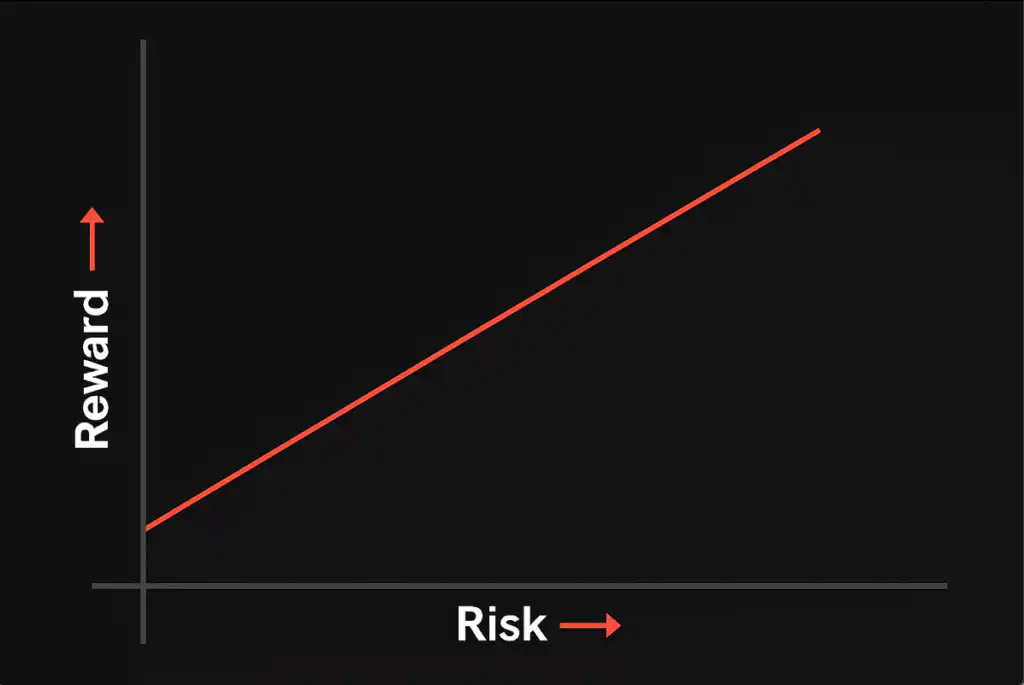
The formula is simple:
RRR = Potential Loss / Potential Gain
It’s important to remember that your potential reward in terms of percentage or dollar value returns grows as your risk grows, but this can be dangerous for your account from a risk management perspective.
Why is the Risk-to-Reward Ratio Important?
Most traders aim for a RRR higher than 1:1, otherwise, their potential losses would be disproportionately higher than any potential reward from a winning trade.
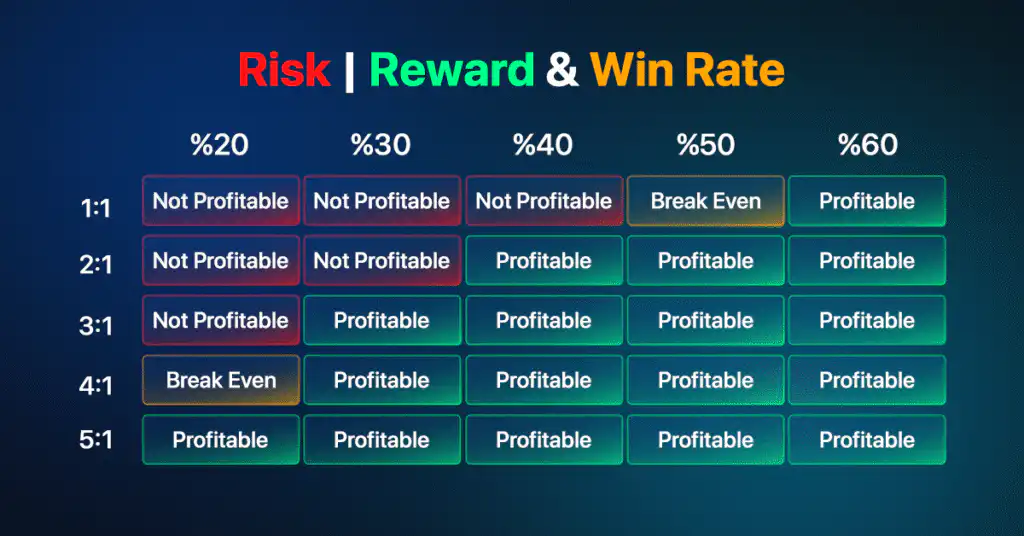
A positive RRR like 1:2 ensures your potential profit is larger than any potential loss. This means that even if you encounter 2 losing trades, you only need 1 winning trade to break even.
The table below represents a few different RRRs and how the Win Rate % correlates to them.
Common Misconceptions
Most traders focus too much on Win Rate and waste their time looking for a trading strategy with 100% WR. Aside from it being a fantasy, 100% Win Rate isn’t even necessary to be profitable.
You don’t even need a high Win Rate to be profitable. It’s the relation of your average win versus your average loss that is the most important metric, and what will make you profitable.
As long as your wins outweigh your losses, you will be profitable. You just have to find the right Risk-to-Reward Ratio that works with the Win Rate your trading strategy offers.
A trading strategy that produces wins only 40% of the time can still be very profitable if your average wins are much larger than your average losses.
Conversely, a trading strategy with 70% Win Rate can lose money if your losses are too large relative to your wins, and this is where RRR shines.
Conclusion
The Risk-to-Reward Ratio is an indispensable tool for any trader. It’s far more than a simple calculation. It creates a framework for decision-making.
Objectively understanding potential trade outcomes, managing your inherent market risk, and approaching opportunities with a pre-planned trading strategy are crucial to your success as a trader.
FAQs
- What are risk and reward?
In trading, risk is the potential loss you take on when entering a trade, while reward is the potential profit you aim to gain if your trade hits take profit.
- What is the Risk-to-Reward Ratio?
The Risk-to-Reward Ratio (RRR) compares how much you will lose (risk) versus how much you will gain (reward) with each trade.
For example, if you risk $1,000 to make $3,000, that’s a 1:3 Risk-to-Reward Ratio.
- How can I manage risk?
Managing risk starts with defining your risk per trade and your Stop Loss before entering a trade.
Never risk more than a small percentage of your trading capital on a single position (commonly 1–2%).
Use proper position sizing, avoid over-leveraging, and remember that preserving capital comes before making profits.
- What’s the best Risk-to-Reward Ratio?
There’s no universal “best” RRR. It depends on your trading strategy, win rate, and market conditions.
Many traders aim for at least a 1:2 or 1:3 RRR, which allows profitability even with a lower Win Rate.