
When it comes to the swing trading vs scalping debate, the entire argument boils down to two things: time and frequency.
Swing trading is about holding your positions for several days or even weeks, aiming to ride larger market waves. On the other side of the coin, scalping is all about grabbing tiny profits from trades that last just a few minutes. Your choice really depends on whether you prefer a patient, big-picture approach or you thrive in a fast-paced, high-volume environment. Understanding and mastering the two different trading styles is essential when taking on evaluations among the top prop firms like MyFundedFutures, AquaFutures, and The Futures Desk.
Foundational Differences Between Trading Styles
Choosing a trading style is like picking a vehicle for a road trip. Swing trading is the steady sedan, built for a long, patient journey where you analyze the map and enjoy the scenery.
Scalping, on the other hand, is a high-performance race car designed for short, intense sprints around a track. It demands constant focus and lightning-fast reflexes.
Both can get you to the destination of profitability, but their methods are very different.
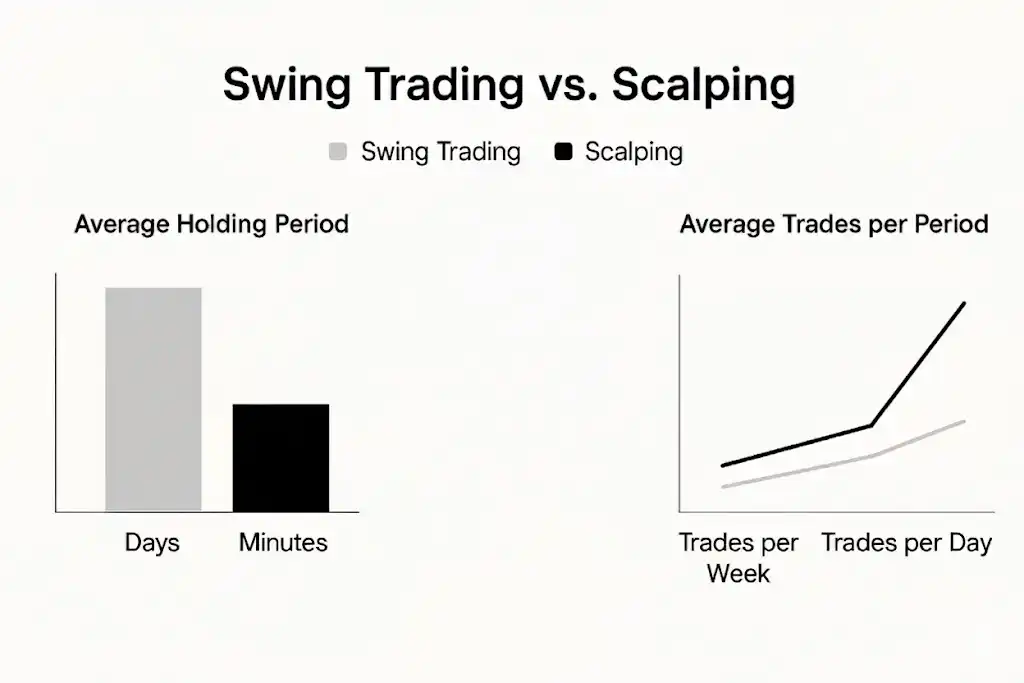
Scalping is a numbers game. It often requires hundreds of trades to stack up meaningful profit. Swing trading, however, is about securing larger gains from just a handful of well-planned positions.
It’s not about one being “better” than the other. It’s about finding what serves your personality and lifestyle.
One strategy chains you to the screen, demanding quick-fire decisions. The other allows for a more relaxed pace, with most of the analysis done before the market has either opened, or after the market closes.
Figuring out these differences is the first step to aligning a trading strategy with your personality, schedule, and financial goals.
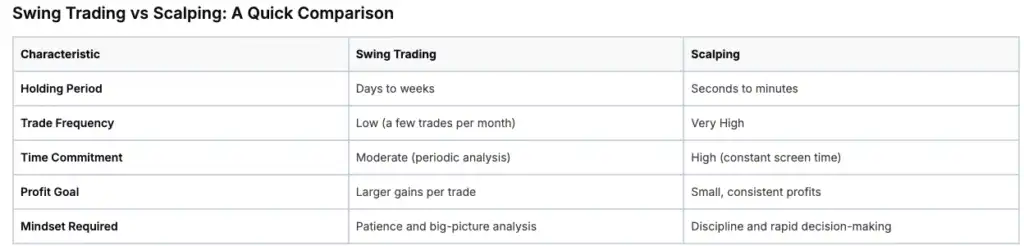
The following table highlights the key differences. It’s a great starting point to see which strategy might suit you better.
Scalping in Prop Firms
Scalpers rely on speed and precision. Scalping traders are focused on short-term setups, usually during high-volatility events and sessions like London and New York.
However, prop firm conditions can make scalping difficult:
- Commission costs increase quickly when taking many trades.
- Execution quality and slippage can lower profit margins.
- Daily drawdown limits make recovery harder after a few losses.
They have to be there when liquidity and volatility are at their absolute peak, as well, meaning scalpers are more “glued” to the screens than swing traders. For instance, a scalper might take 5 trades on EURUSD in a three-hour window, just trying to squeeze a few pips from each one.
It’s an intense, exhausting process that requires a lot of discipline and focus.
Swing Trading in Prop Firms
Swing trading, on the other hand, is the complete opposite. It’s built for traders who can’t, or simply don’t want to, dedicate their entire day to watching charts.
You analyze the markets beforehand, plan entries around liquidity or key levels, and let the trades develop over several days if needed.
Traders often compare scalping to a machine gun approach, whereas swing trading is like being a sniper: you only “shoot” at the best opportunity.
For prop firm traders, swing trading offers:
- Lower transaction costs since fewer trades are placed.
- More time for analysis and risk management.
- Easier compliance with news restrictions and firm-specific rules.
The main risk is overnight or weekend exposure. Gaps or surprise news events can trigger drawdowns, which is why proper position sizing is essential.
Which Style Fits Your Personality?
Your daily schedule is the first big filter. If you have a full-time job or other major commitments, swing trading is almost always going to be the more realistic choice.
It lets you do your homework after the market closes and set trades that don’t require you to be glued to the screen all day.
Scalping, on the other hand, is a job in itself. It’s a high-intensity sprint that demands your undivided attention during peak market hours.
This is for full-time traders who can set up a professional, distraction-free zone to execute with razor-sharp precision.
Beyond your schedule, your own psychology is a huge piece of the puzzle. If you force a strategy that goes against your nature, you’re just signing up for stress and bad decisions.
Ask yourself a few honest questions:
- Are you patient? If you genuinely enjoy digging into research and can handle waiting days for a setup to play out, swing trading will feel natural.
- Do you thrive under pressure? If you have lightning-fast reflexes and can make split-second decisions without getting emotional, you might be built for the fast-paced world of scalping.
- How do you handle risk? Swing traders need to be okay with holding positions overnight and weathering market swings. Scalpers need to accept the fact that they’ll take many small losses. It’s just part of the game.
Final Thoughts
Both swing trading and scalping can succeed within prop firm environments if you manage risk correctly. Scalping rewards precision and discipline, while swing trading rewards patience and planning.
Choose Swing Trading if:
- You have limited screen time.
- You prefer quality over quantity in your trades.
- You can hold positions without reacting emotionally to small fluctuations.
Choose Scalping if:
- You trade full-time and perform well under pressure.
- You have the discipline to stay consistent through dozens of trades.
- You use reliable brokers with tight spreads and low commissions.
There is no single “better” strategy. What matters is choosing a method that fits your lifestyle and psychology, then staying consistent.
If you are trading challenges or funded accounts, focus on capital preservation by being selective with your trades and having proper risk management. We have a full breakdown of how to approach prop firm risk management here.
No matter which style you choose, cutting your costs is always a winning move. PipBack gives you exclusive discounts on prop firm challenges, giving both scalpers and swing traders an edge from day one.
Get your discount and start trading smarter today.
FAQs
- Which is better for prop firm challenges: swing or scalp trading?
Swing trading is usually better for beginners because it involves fewer trades and a lower chance of violating drawdown limits. Scalping suits experienced traders who can manage execution and costs efficiently.
- Can I combine swing trading and scalping?
Yes, but keep them separate. Mixing them without a clear plan can cause emotional mistakes and inconsistent performance.
- Why do scalpers struggle in prop firms?
Scalpers face higher transaction costs, slippage, and rule restrictions. Many prop firms make it difficult to maintain consistency with high-frequency trading.