

Your Trailing Drawdown limit increasesIf you’re currently funded by a prop firm or planning to buy a prop firm challenge, there’s one concept you absolutely need to master: drawdowns.
Risk management is the key to passing prop firms’ challenges and getting funded capital. If you don’t understand how prop firm drawdowns work, you can’t have proper risk management when taking on challenges among sites like Lucid Trading, The Futures Desk, and MyFundedFutures.
In this article, you’ll understand:
- How prop firm drawdown works
- The different types of drawdown
- The best drawdown to trade with
- How to calculate your drawdown
What is a Drawdown?
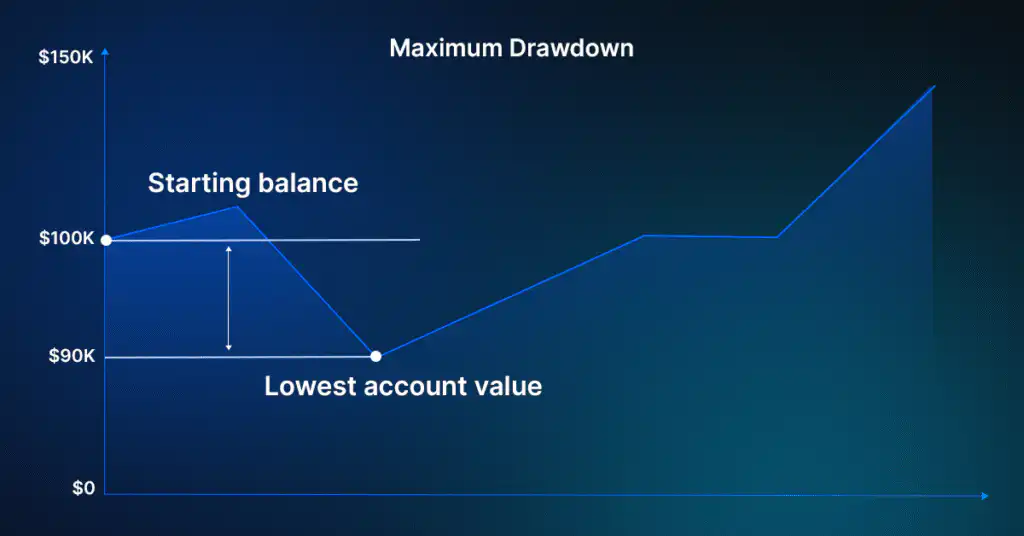
A drawdown is the amount your trading account falls from its starting balance to a low point.
You’ll be working with a Maximum and Daily Drawdown in your prop firm challenges, so let’s break down what they mean for your trading.
Maximum Drawdown & Daily Drawdown
Maximum Drawdown
The Maximum Drawdown (Max. DD) is the maximum percentage a trader can lose from their account for its entire duration, before losing the account. This is also calculated from the account’s starting balance. For example, Forex prop firms usually offer 10% Max DD. If your account balance hits $90,000 on a $100,000 account, you will breach the Maximum Drawdown rule and lose the account. If you increase the account to $103,000 and $105,000 in the following days, the Max. DD will still remain at $90,000.
 Daily Drawdown

Daily Drawdown (Daily DD) is the maximum amount you’re allowed to lose in a single day. This is usually 3-5% and is based on the account’s equity, not the starting balance. We’ll go into more detail about the differences between balance and equity-based drawdowns in the article. For now, you need to understand that the Daily Drawdown is based on the equity of your account. Every day at 00:00 UTC, prop firms look at your current account equity and calculate the Daily DD based on it.
If you start with $100,000 on Monday and bring the account up to $105,000 by the end of the day on Tuesday, your Daily Drawdown will be 5% from $105,000.
If you lose 5% within a single day, you will lose the account. Should you lose 4%, however, your Daily Drawdown resets at 00:00 UTC. You’ll start the next day off at $101,000.
Therefore, your Daily Drawdown on Wednesday would be $95,950 (5% from $101,000).
It’s important to remember that open trades at 00:00 UTC will also influence the Daily Drawdown calculation. Depending on the open P&L of your trade, the Daily DD Limit might move up or down.
This means that if a trade was in a profit of $3,000, bringing your account balance to $103,000 at 23:59 UTC and then rapidly declines after 00:00 UTC, your Daily Drawdown Limit will get calculated based on $103,000, and you’ll start the next day in drawdown already.
Types of Drawdowns

Every different prop firm challenge will have a different drawdown as well. Make sure you first understand the different types of prop firm evaluations.
What’s a Static Drawdown (Balance-Based Drawdown)?
A balance-based drawdown is any drawdown that’s calculated from your account balance. It’s often referred to as Static Drawdown.
In the prop firm space, it’s always calculated from the starting account balance.
Forex prop firms use a balance-based Maximum Drawdown. Regardless of how much profit you’ve made, your Max. DD will still get calculated from the starting balance of the account.
To calculate the balance-based Maximum Drawdown of your account, you’ll need two things:
- The maximum drawdown % allowed by the prop firm (e.g., 10%)
- The starting balance of the account (in this case, $100,000)
Max. DD = 100,000 x 0.10 = $10,000
Your account must not fall below $90,000. If it does, you’ve breached the Max. DD limit and will lose the account.
Even if your account is 5% in profit and you’re sitting at a balance of $105,000, your Maximum Drawdown is still $90,000 since it’s static (based on the starting balance).
What is a Trailing Drawdown (Equity-Based Drawdown)?

The Static Drawdown (balance-based) is a fixed amount you’re allowed to lose before your account is breached. It stays in one place and doesn’t change, no matter how much you make or lose.
Compared to it, the Trailing Drawdown moves up and trails your highest account balance or equity. It’s often referred to as Dynamic Drawdown, and there are different types of Trailing Drawdowns that we’re going to cover.
As your balance climbs, the Trailing Drawdown limit climbs as well. But once it moves up, it never moves back down.
💡 Trailing Drawdown = Highest account balance – the amount you’re allowed to lose
Example: You start a prop firm challenge with $100,000 with a 10% Maximum Drawdown (i.e., a trailing drawdown). This means you’re only allowed to lose $10,000 and can’t go below $90,000.
If you make $5,000 and grow your balance to $105,000, the Trailing Drawdown limit will be $95,000. You will breach the challenge if your account’s equity drops below that.
If you grow the account to $110,000, your Trailing Drawdown limit moves to $100,000. It always trails the highest account balance by $10,000.
Let’s break down the different types of Trailing Drawdown:
How does the EOD Trailing Drawdown work?
In prop firm trading, the Daily Drawdown is an End-Of-Day Trailing Drawdown.
Prop firms look at your end-of-day account equity at 00:00 UTC and calculate your Daily Drawdown for each day based on that.
- It does not affect your Maximum Drawdown and resets every trading day.
- As long as you don’t hit a 5% loss within a day, you are not in risk of losing your account.
Example: Forex prop firms usually have a 5% Daily DD. Let’s break down the calculation.
Day 1
Account Balance = $100,000
Daily Drawdown = $5,000 (5% of $100,000)
Daily Drawdown Limit = $95,000
If your account’s equity drops below $95,000 within a single day, you will lose the account.
Day 2
Account Balance = $105,000
Daily Drawdown = $5,250 ($5% of $105,000)
Daily Drawdown Limit = $99,750
If your account’s equity drops below $99,750 within day 2, you will breach the Daily DD rule and lose the account.
Day 3
Account Balance = $103,000
Daily Drawdown = $5,150 (5% of $103,000)
Daily Drawdown Limit = $97,850
If your account’s equity drops below $97,850 within day 3, you will breach the account.
How does the Intraday Trailing Drawdown work?
This type of drawdown is usually used by Futures prop firms. It works as both their Maximum and Daily Drawdown since they have only 1 phase in their evaluation.
An Intraday Trailing Drawdown climbs up as you grow your account with each trade during the day, and trails the highest account balance. Of course, it does not climb back down if you take a loss.
Futures prop firms usually have a 3% Intraday Trailing Drawdown, which is fixed in USD for the account size you purchased.
Example:
If you have a $50,000 account, your Trailing Drawdown is $1,500. This means that your Trailing Drawdown limit is always $1,500 behind your highest account balance.
Starting Account Balance = $50,000
Trailing Drawdown = $1,500 (3% from $50,000)
Trailing Drawdown Limit = $48,500
If your account’s equity drops below $48,500, your account will be breached.
Account Balance after 2 trades = $51,500
Trailing Drawdown Limit = $50,000
Since your account grew to $51,500, the Trailing Drawdown limit trails the balance by $1,500.
Account Balance after 3 trades = $53,000
Trailing Drawdown Limit = $51,500
The Trailing Drawdown moves up again and is always $1,500 behind your account balance.
Account Balance after 4 trades = $52,000
Trailing Drawdown Limit = $51,500
The Trailing Drawdown remains at $51,500 since the highest account balance was $53,000 before the trader took a loss. This means that the account has only $500 worth of drawdown to work with.
There’s a key component that can make the Trailing Drawdown a lot harder for traders. Let’s look at that next.
Drawdown Landmines in Volatile Market
When you are not careful, there are instances when your account may suddenly be breached while trading in a volatile market. Below are the drawdown landmines to watch out for:
News Trading
Trading the news is highly unpredictable. Markets, especially Forex, could go either bearish or bullish depending on the trader’s sentiment for the price. You could experience massive equity swings with a breaking news event at a time when liquidity and volatility is high. While you can see a massive gain on your trades, the market may move against you and set you closer to the drawdown limit.
Revenge Trading
The term revenge trading involves winning back losses, which is often triggered when a trader sees their account about to breach the drawdown limit. This is a dangerous trading behavior that opens you to aggressive moves that are incredibly risky with a low return. Stick with a trading strategy that has been working for you. If you experience losses through scalping and day trading, try swing trading.
Overtrading
One of the common factors shared by most breached accounts is the number of trades they make, which is more than those who passed their account. Too many trades increase your exposure to volatility and slippage risks. It also lessens your equity for profitable opportunities should they come.
Realized vs Unrealized Trailing Drawdown
We mentioned that a Trailing Drawdown can either trail the account balance (balance-based Trailing Drawdown) or the account equity (equity-based Trailing Drawdown).
This is determined by the prop firm and whether the Trailing Drawdown is Realized or Unrealized.
Realized Trailing Drawdown:
A Realized Trailing Drawdown is technically a balance-based Trailing Drawdown. This means that the Trailing Drawdown Limit moves up only if a trader realizes his profits.
For example, if you have a running trade in $3,000 of profit on a $50k account, your Trailing Drawdown is still at $48,500 (3% from $50,000). You have not realized the profit yet, therefore, the Drawdown remains based on your current account balance, which is still $50,000.
Once the trader closes his position and realizes the $3,000 gain, bringing his account to a balance of $53,000, the Trailing Drawdown Limit moves up to $51,500 since it trails the account balance.
Unrealized Trailing Drawdown:
An Unrealized Trailing Drawdown is by far the hardest to trade with. It’s based on the account’s equity and trails up even if the trader has not realized his profits.
If we use the same example as above, the trader would see his Trailing Drawdown Limit already move up to $51,500 even when he hasn’t realized his $3,000 profits.
This means that if the trade goes against him and the account equity drops below $51,500, the trader will breach his account. Even if the trade ends up being a breakeven and the trader doesn’t end up losing money, the Trailing Drawdown Limit has moved up already.
An Unrealized Trailing Drawdown requires stricter risk management and trailing your stop loss accordingly. Don’t sit on large floating profits and look to secure something in case the trade goes against you, while keeping the DD Limit at a favorable distance.
What’s the Best Type of Drawdown and How to Choose?
What type of Maximum and Daily Drawdowns you will work with ultimately depends on whether you’re trading with Futures or Forex prop firms.
Forex Prop Firms
If you’re trading with Forex prop firms, you’ll rarely have to deal with anything other than a Static Max. Drawdown and an EOD Daily Drawdown.
PipBack recommends looking for the usual 10% Max. DD and 5% Daily DD when picking a Forex prop firm. If you want to explore reputable Forex prop firms and enjoy huge discounts for your prop firm purchases, check out our offers for major firms like Goat Funded Futures and AquaFutures. It’s also important to pay attention to the Profit-to-Drawdown Ratio while choosing a prop firm to trade with.
Futures Prop Firms
Futures prop firms operate differently from Forex prop firms, and in most cases, you’ll have a combined Maximum and Daily Drawdown. This will be just one Drawdown Limit, which if you hit, will breach your account.
Most Futures prop firms emphasize very strict risk management and will work with Trailing Drawdowns.
If you can, PipBack always recommends looking for a challenge with a Static Drawdown. This will make it a lot easier to pass the evaluation, and you won’t have to worry about realized vs unrealized profits or trailing your stop loss.
The second-best option, if available in your prop firm of choice, is a balance-based Trailing Drawdown. If you want to explore Futures prop trading, check out PipBack’s partnered Futures prop firms and enjoy large discounts for top sites like TakeProfitTrader, Tradeify, and Apex Trader Funding.
FAQs
- What is a drawdown in prop firm trading?
- A Drawdown in prop firm trading is a fixed amount you’re allowed to lose before your account is breached.
- What is the difference between a balance-based and equity-based drawdown?
- A Balance-based Drawdown considers closed trades only. An Equity-based Drawdown includes open trades and floating profits as well.
- How does a trailing drawdown work?
- A Trailing Drawdown moves up and trails your highest account balance or equity by a certain amount. It’s also known as a Dynamic Drawdown.
- What’s the best type of drawdown?
- Types of drawdowns vary according to every trader and their strategy. The easiest types of drawdowns to trade with are generally Static and EOD Drawdowns.
- Do prop firms reset your Drawdown Limit if you make a withdrawal?
- Most prop firms reset the Drawdown Limit based on your new, post-withdrawal balance or equity, while others keep it tied to your original funded amount. It’s important to read through the prop firm rules and make sure you’re not breaching a Drawdown Rule by withdrawing too much from your account balance.
- How is EOD drawdown different from intradaw drawdown?
- The EOD drawdown is calculated upon the session’s closure or end of a trading session. On the other hand, intraday drawdown is calculated in real time or is adjusted automatically as your account’s equity grows.